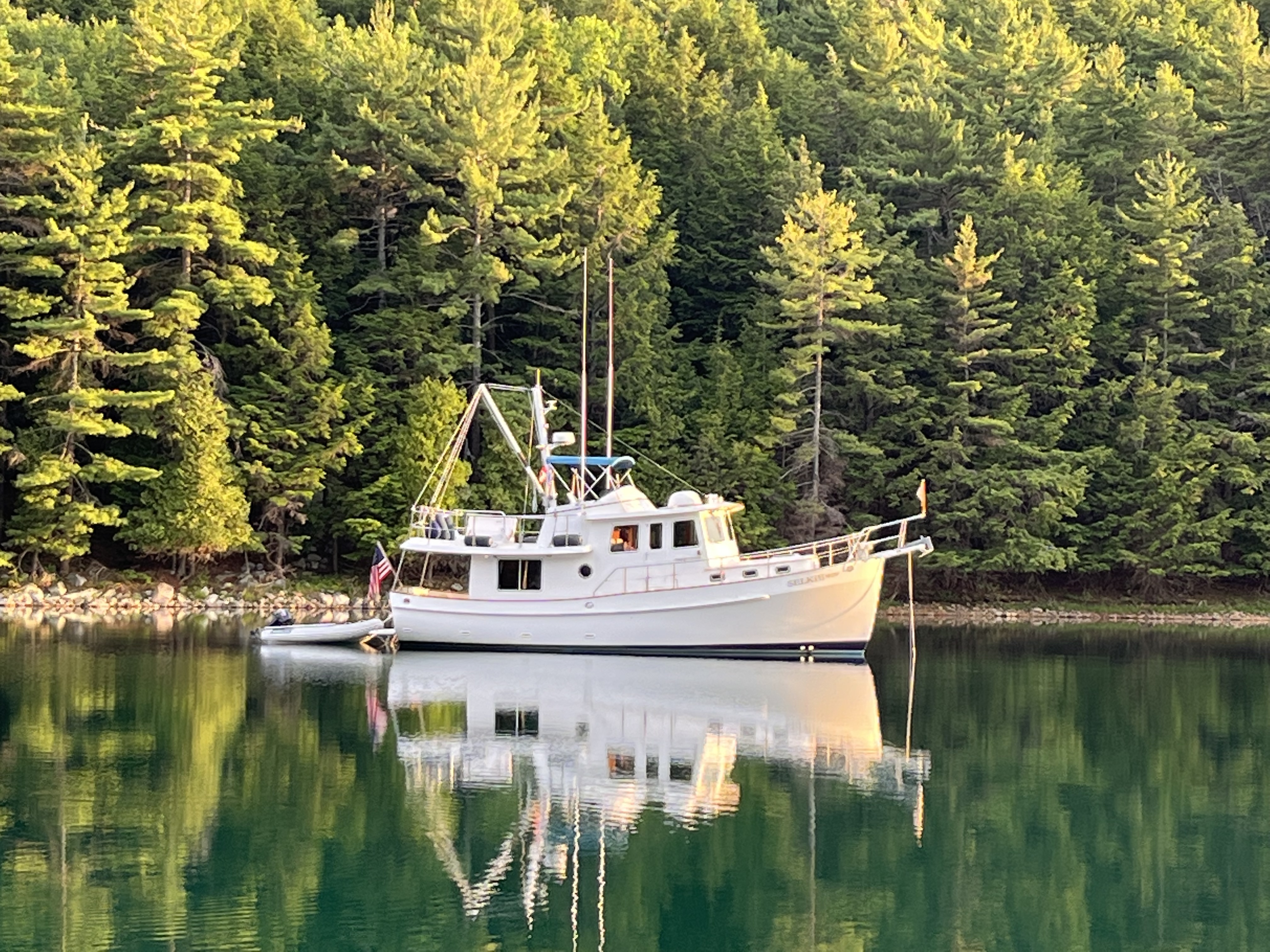
The Illinois River turned into a quite a pretty passage.
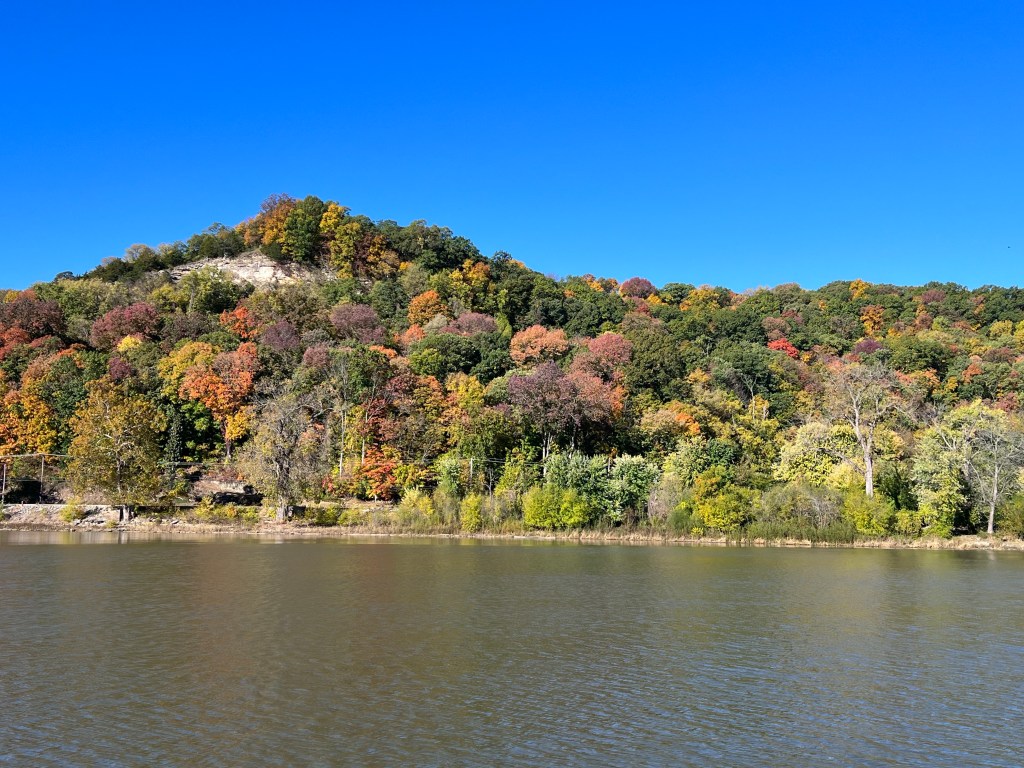
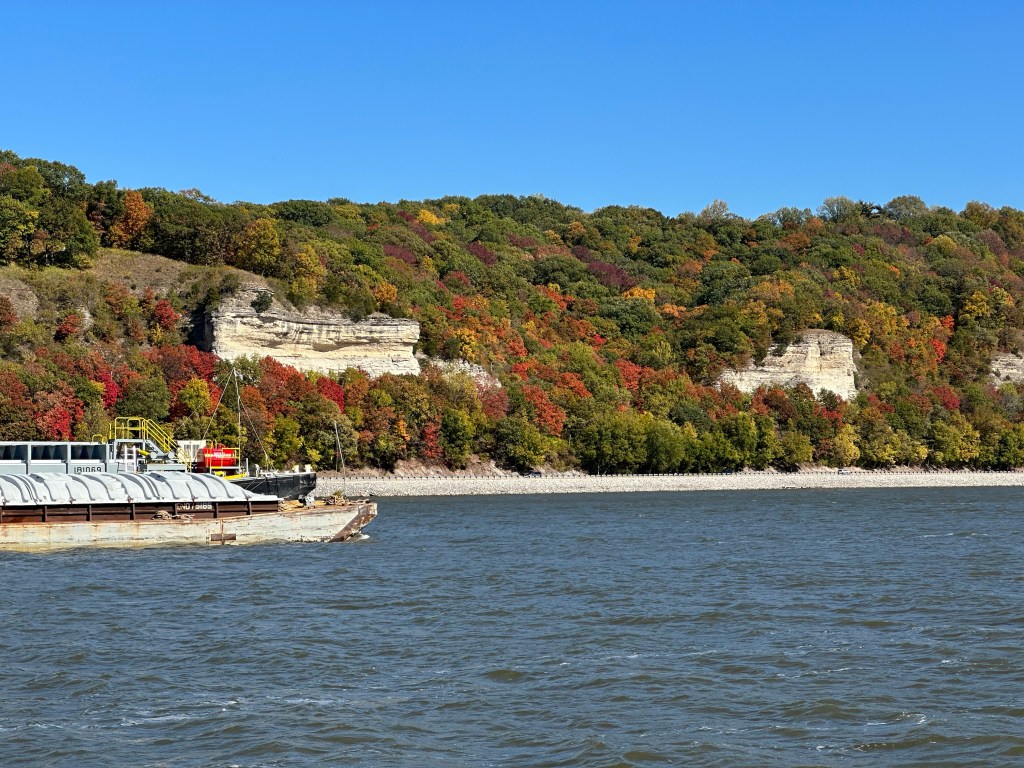
We saw high limestone bluffs with mostly green trees, but some fall colors started to appear in red and browns and yellows
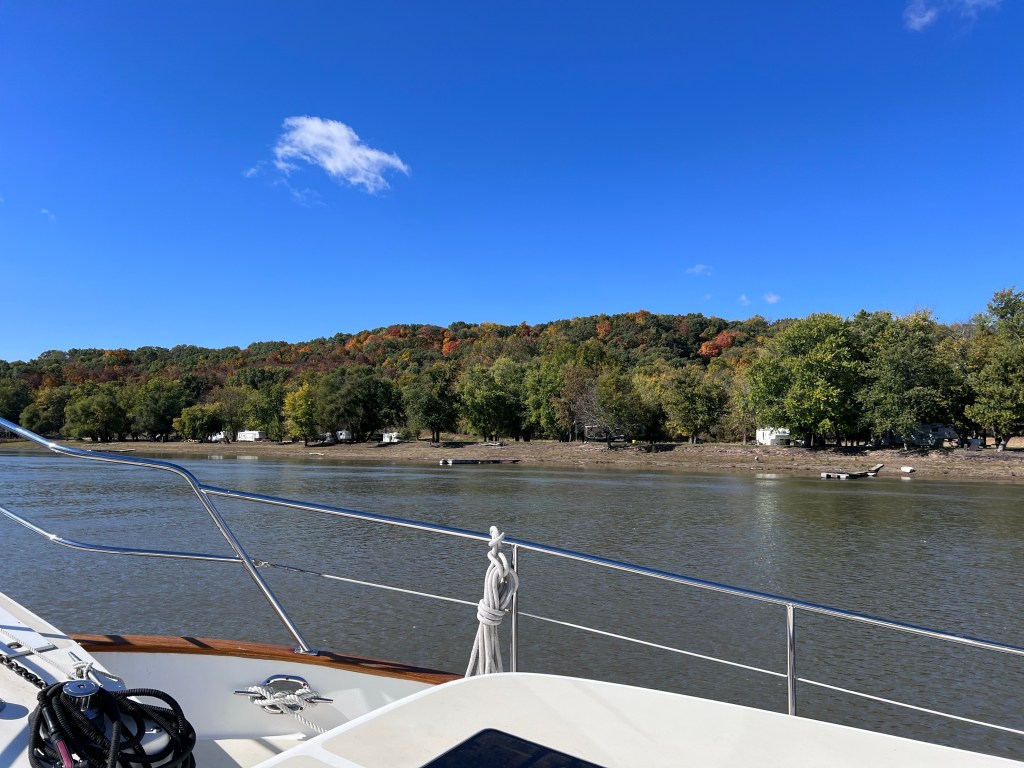
Life is a little bit different here than it is on the Great Lakes.
We don’t need to worry about big waves and long crossings on open water.
Instead, we worry about narrow passages and staying in the channel so we don’t run aground..
At mile marker 49 on the Illinois river we passed the halfway point for our loop.
That’s 3000 miles that we’ve gone and it was quite an uneventful event.
There was a big herd of Loopers behind us and we did not want to get caught by them before we got to the Mississippi. So we felt the pressure to “keep a move on.”
Libbie and I just looked at each other, acknowledged the moment and continued on. We were both tired from the long river days so far.
We will celebrate in a couple of days when we reach Alton, Illinois where we plan to stop for a few days.
Growing up on the Great Lakes I fondly remember recognizing freighters as they went by on the Straits of Mackinac.
You could identify the freighter sometimes based on their shape and the colors of the smokestack dictated by the companies that owned them.
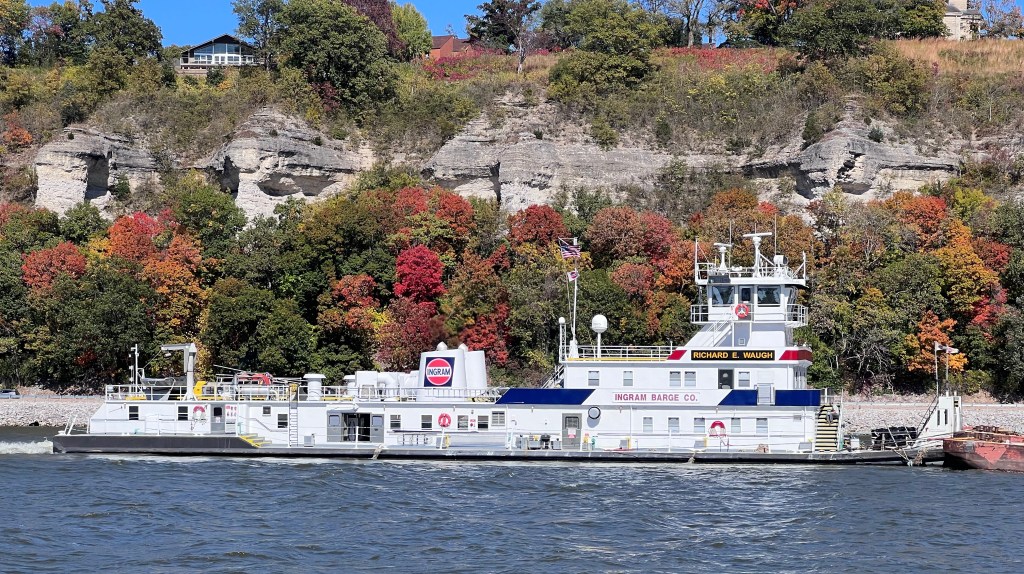
I hadn’t really realized it until we got on the Illinois river but there are an equal number or more tugboat companies that operate on the River System, with their own naming structure and company colors.
Some tugs are small but some are behemoth.
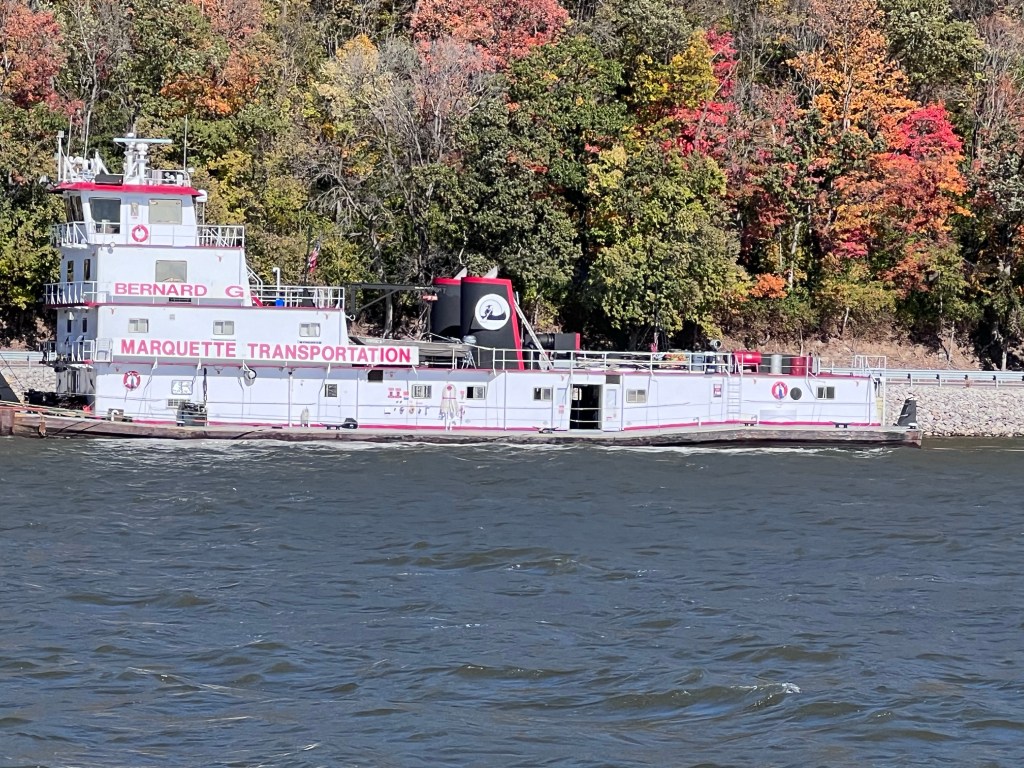
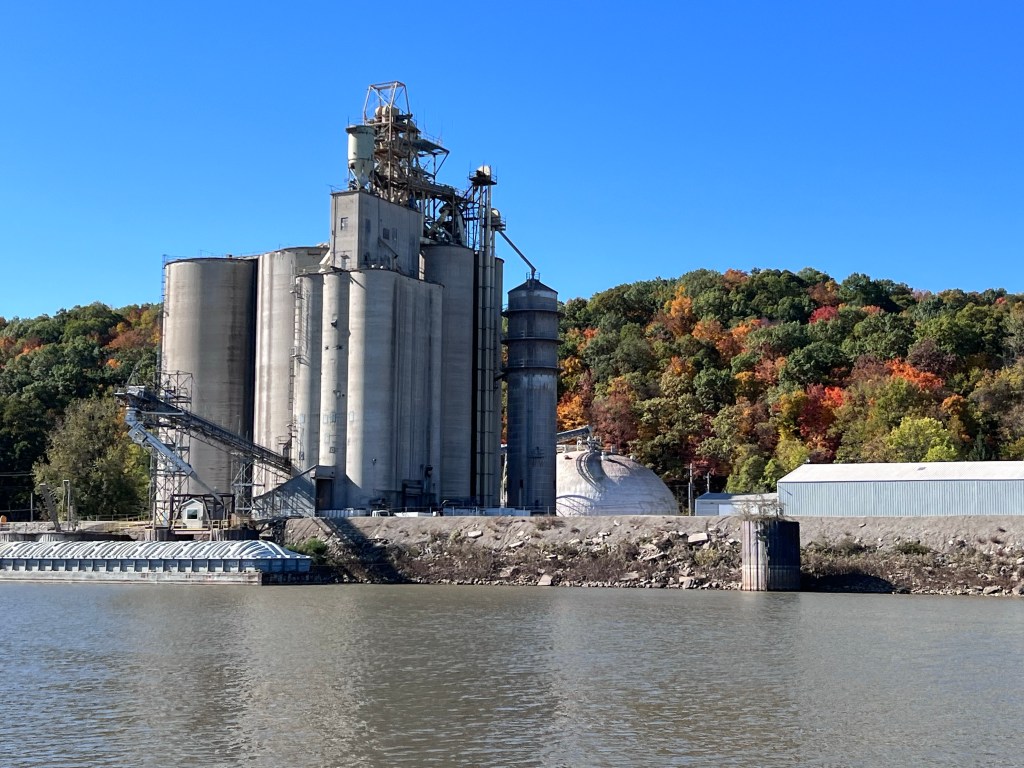
The upper part of the Illinois river is focused, more on industry with coal, bulk manufacturing supplies and building materials delivered and stockpiled along the river.

The lower part of the Illinois is definitely farmland surrounded by forest. Grain silos become much more common along the lower banks of the Illinois .
After leaving the IVY club, we continued through Peoria and locked through the Peoria lock.
The Peoria Lock and the Lagrange Lock below it have interesting damn structures next to them called wicket dams.
Wicket dams are temporary dams operated by the Army Corps of Engineers.
The dams are built from steel plates folded down by hydraulic rams across the bottom of the river to let the river flow unrestricted during times of high water.
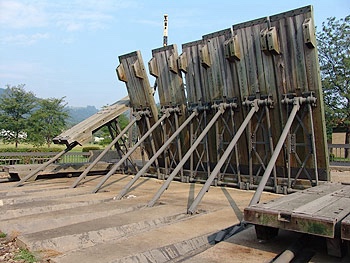
When the water levels go down, the Corps activate the dams using hydraulic pressure to raise the plates up. This maintains the minimum 9’ of depth for towboats to operate upstream on the Illinois during times of low water flows.
When the wickets are down, you don’t go through the locks. You just continue straight over the wickets as the water is high enough to clear them.
When the wickets are up, you have to go through the locks.
In our case, the wickets were up so that is what we did.
We went through the Peoria locks just fine. It’s only about a 10 foot drop.
From there we went to our anchorage at Bar Island.
Some Loopers like to tie up to a towboat operation in Beardstown but it’s just a barge with no services.
There’s also a high flood wall to protect the town from the flooding so it’s difficult to get into the town.
We’re finding that many of the loopers like to dock instead of anchor and we are a little opposite.
When there’s an opportunity for a nice spot to anchor we prefer that. So that’s what we did.
It does limit us in terms of the number of docktales we can participate in, but that’s ok.
We can docktale by ourselves just fine.
We went down to Bar Island and anchored for the night. It wasn’t the best anchorage we’ve stayed at but it was safe. It was exposed to the wind, which was fighting the current coming from the other direction.
As a result we kind of drifted around the anchor all night. But we are safe and we slept OK.
The next morning we headed down to the Lagrange Lock.
We barely made it as there is some pleasure craft ahead of us and the lockmaster was anxious to get a large towboat with 15 barges through. Thankfully they let us in.
There were some other Loopers we were in contact with behind us that wanted the lock to stay open longer.
But with the towboat waiting to lock through, the lockmasters closed the gates behind us as we entered.
The Loopers waited about 2 hours for the towboat to clear the locks before they were allowed in. We felt bad for the loopers.
We have been enjoying the Illinois countryside with the big trees, the rolling hills, the limestonebBluffs over the river, and the changing fall colors.
The next evening we were planning to anchor at Willow Island but it looks like it was going to be the same as Bar Island, which was ok, but exposed to the wind.
We carried on to “The Dark Chute” behind Hurricane and Diamond Island. This was a lovely anchorage in 15′ of water.
It was off the main channel, and quiet, except for the crickets in the evening. It bothered Libbie more than me. To me it was hard to tell the crickets from the tinnitus.
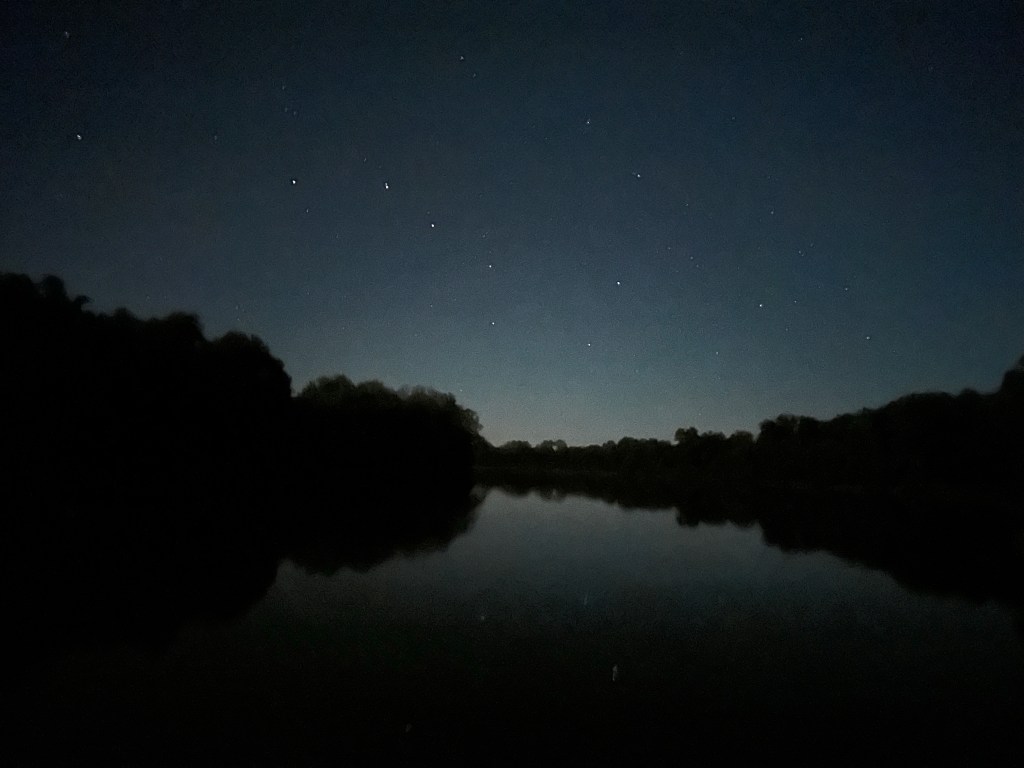
As we got closer to the Mississippi, the high bluffs on the right side of the Illinois river gave way to low lands.

This area is a big floodplain where the Illinois and the Mississippi come together in the spring time.
The levee the houses sit on often flood along here.
You can tell that the flood waters can get pretty high because the homes are built on 10 to 20 foot tall stilts on top of the levee.
It was interesting to see these homes. I’m sure some are cabins for people who enjoy the river on holiday. The Illinois has a lot to offer in terms of water activities. The area is known for its hunting as well.
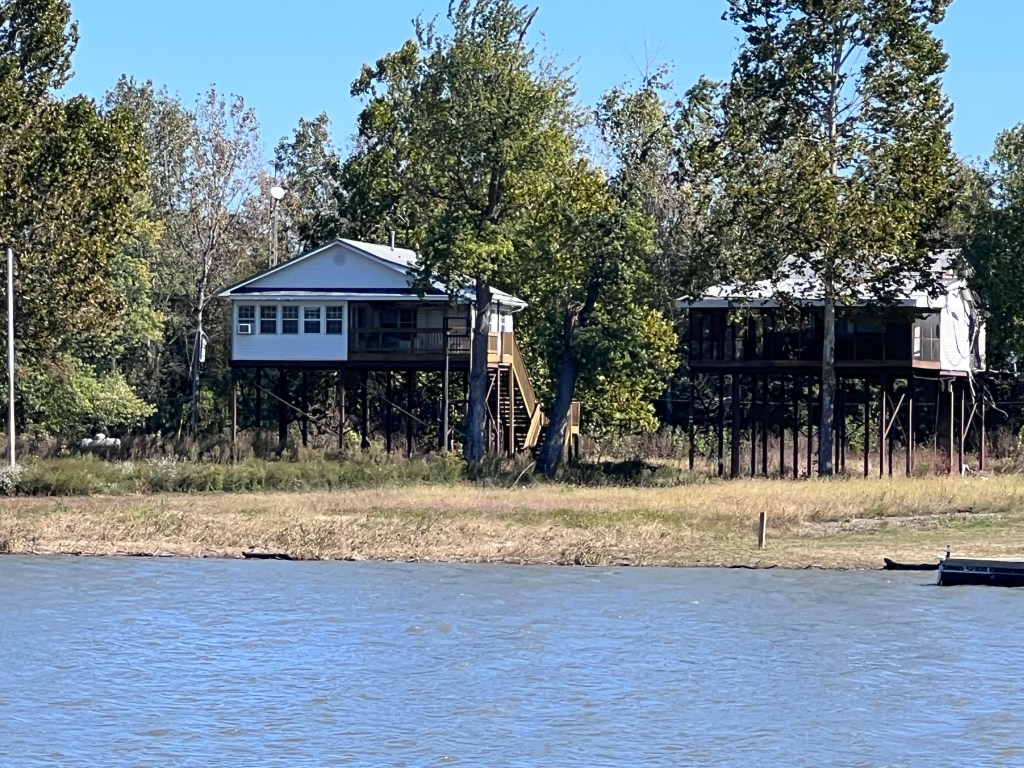
I’m sure sitting on one of these home’s decks would be fascinating with a cold drink and hand, watching the barges and the world go by.
A few of the islands along the Illinois river, have these massive pumps and pump water into the interior of the island.
Apparently, it’s quite a spot for a duck hunting in the fall. They flood the interior of the islands to make the duck habitat and people have a bunch of duck blinds on the islands.
As we reached the mouth of the Mississippi the limestone bluffs appeared on the east side. The water was deeper, the bluffs higher, the river much wider, and then, just like that, we joined the Mississippi.


 Selkie
4 replies on “Farewell to the Illinois”
Congratulations on the halfway mark. Love your blog. Keep it up. Julie and Scott
LikeLike
Wow… love the pix and the tales…stay safe. Hugs from Texas!!! P WHAT
LikeLike
You are lucky it is a dry time. We had 12kt current and submerged buoys on the Mississippi. A couple of rough stops ahead before the Ohio.
LikeLike
You and Libbie must get along Really well…..roll, roll rolling along!
Looks beautiful. Missing you!
LikeLike