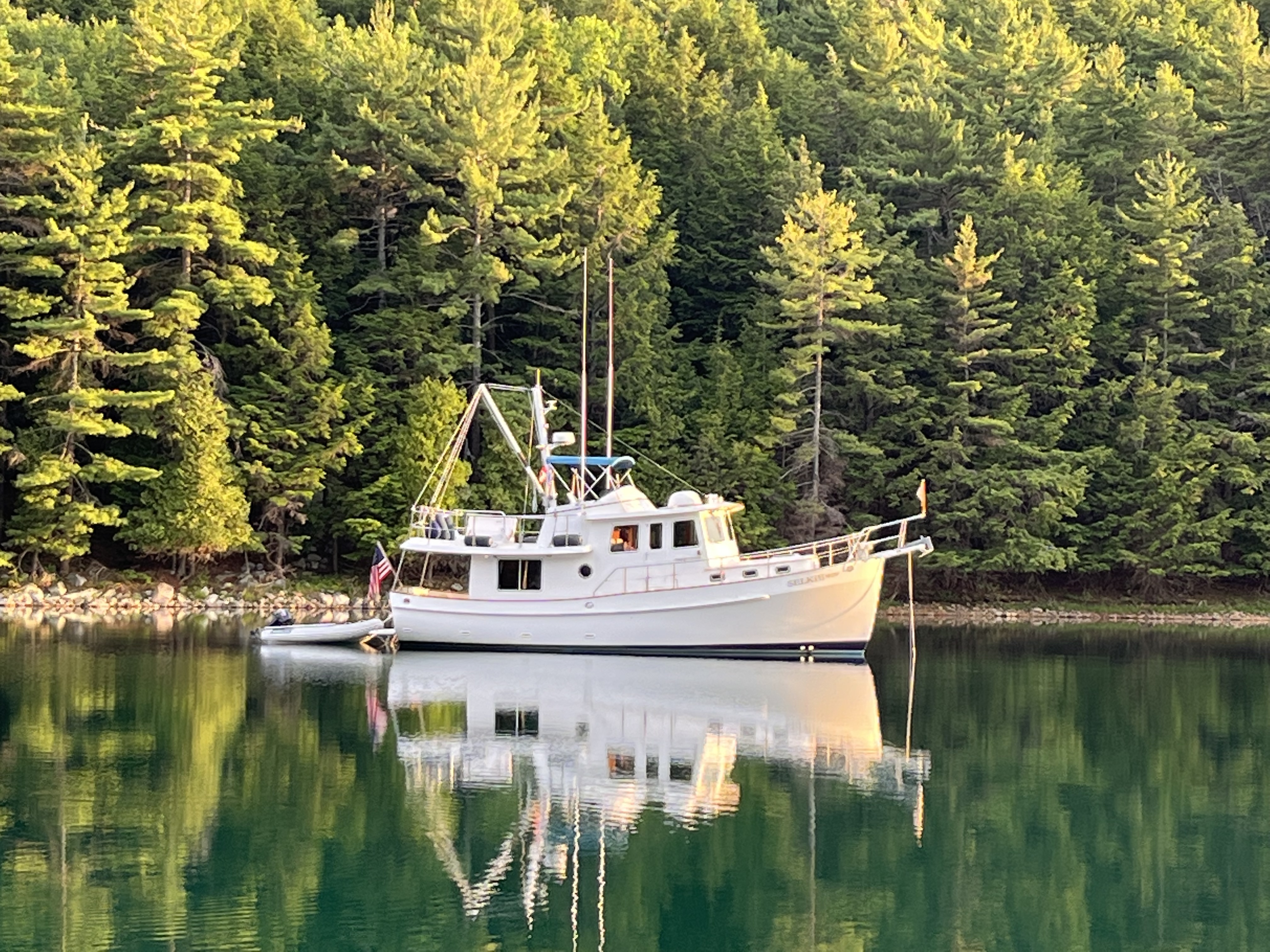
That was an interesting start to October.
By now, those of you who have been following Selkie.blog know that we had Selkie stored outside under cover in Port Charlotte, Florida, between Charlotte Harbor and the Gulf of Mexico.
When we decided to leave Selkie in Florida for the summer, we had to make some big decisions:
- Where were we going to put her
- What condition would we leave her
- How was she going to be cared for while we were away
- What could we do to protect her if or when a major named storm came wandering by
- How were we going to be able to check on her during the three seasons we were leaving her for, spring, summer and fall?
To decide where to put Selkie, we had some significant, important choices to make.
In water, whether salt or brakish or fresh? Or out of the water, in a protected building or out in the open?
Leaving Selkie in the water, tied to a dock had many risks.
There was the risk of having the bottom foul with a lot of marine growth, and have a diver clean her regularly and check zincs.
If a named storm came by, there was typically storm surge, which has a great potential to damage both boats and marinas. We saw many examples of hurricane damage the further south we went towards Fort Meyers on the Gulf Coast, with damage still evident 1.5 years after Hurricane Ian, a Cat 5 storm, came ashore over Charlotte Harbor Bay.
Pulling Selkie out and putting her on the hard made more sense. The question for us was going to be where.
We did some research. There were some places inland in Florida that had air conditioned storage, similar to the heated storage we experienced at Walstrom Marine in Cheboygan, Michigan.
The issues we were trying to protect Selkie from this time was not freezing temperatures, but humidity, damaging winds and flooding.
There are several places that offer this service in Florida, but they are not cheap. In fact they seemed to run about two to three times the cost of what it was in Michigan.
This cost made sense, as in around the Great Lakes, there’s a lot more of these facilities per boat than in Florida.
What about storage outside? What about the elevation, in case there was flooding?
Through networking in the Looper community, we heard of Safe Cove, Inc in Port Charlotte, Florida.
Safe Cove was close by on the southwest side of Florida, it was the go-to for everyone in the area who needed storm protection for their boat, and best of all, folks seemed to be happy with the service team.
We inquired and were very pleased with the cost. It was cheaper than having a slip in the water for most marinas in the area, it was about 20% of the cost to store her in an air conditioned building, and we could put it under a shelter to keep the sun and rain off Selkie.
So, we chose Safe Cove to store Selkie for the months we were going to be gone.
The next issue to solve was how to prepare Selkie.
With the high temperatures and humidity, we could not just park her and walk away. Mold and moisture would quickly become a problem, and that isn’t good for any boat.
With the potential named storm activity, we needed to make sure things were stored properly and not in an exposed area where strong winds would rip things away.
We researched “How to Store Your Boat in Florida” and came up with a protocol.
We purchased some things to help with humidity:
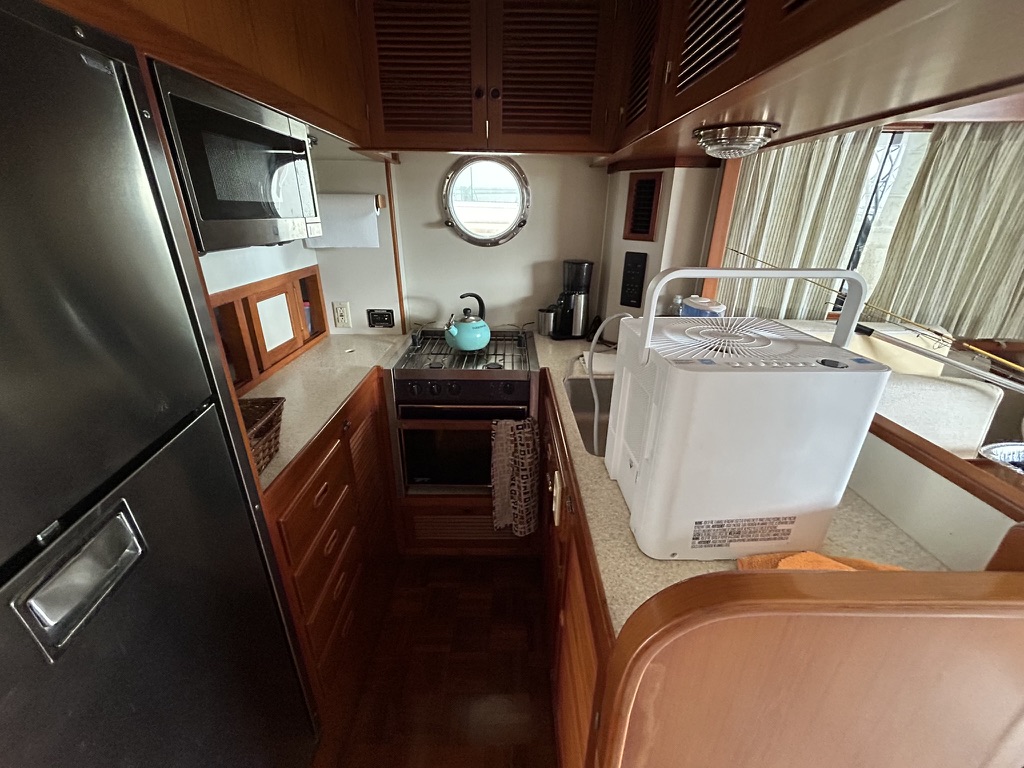
- Dehumidifier with Wifi Capability
- Foil Trays and Charcoal
- Large article vacuum sealing bags
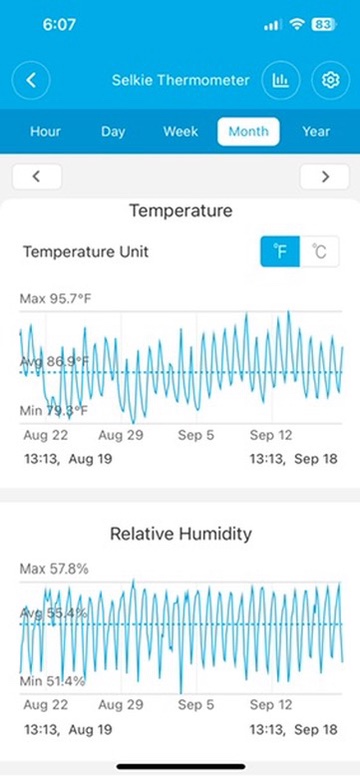
- A temperature and humidity sensor with Wifi capability
We purchased this through Walmart and had it shipped to Safe Cove Inc. for our arrival (we have become big advocates for the conveniences offered by Walmart on the Loop).
The foil trays and charcoal were for odor control. The sealing bags were for clothing, bedding and towels that we were leaving on Selkie
Before Selkie was hauled out and put on stands, we brought Selkie to our friends’ house, and put her at her dock. We had a frenetic 2 days packing anything capable of getting moldy away, setting up our humidity abatement protocols and preparing the outside of Selkie for minimum windage by lowering the radar mast and canvas bimini top for the flybridge. We stored any extra canvas inside.
We deflated and tied down the dinghy to her stand on the top deck. We put the outboard motor in the cabin to prevent theft.
We then drove her over to Safe Cove.
Safe Cove pulled her and had her in her shelter within an hour.
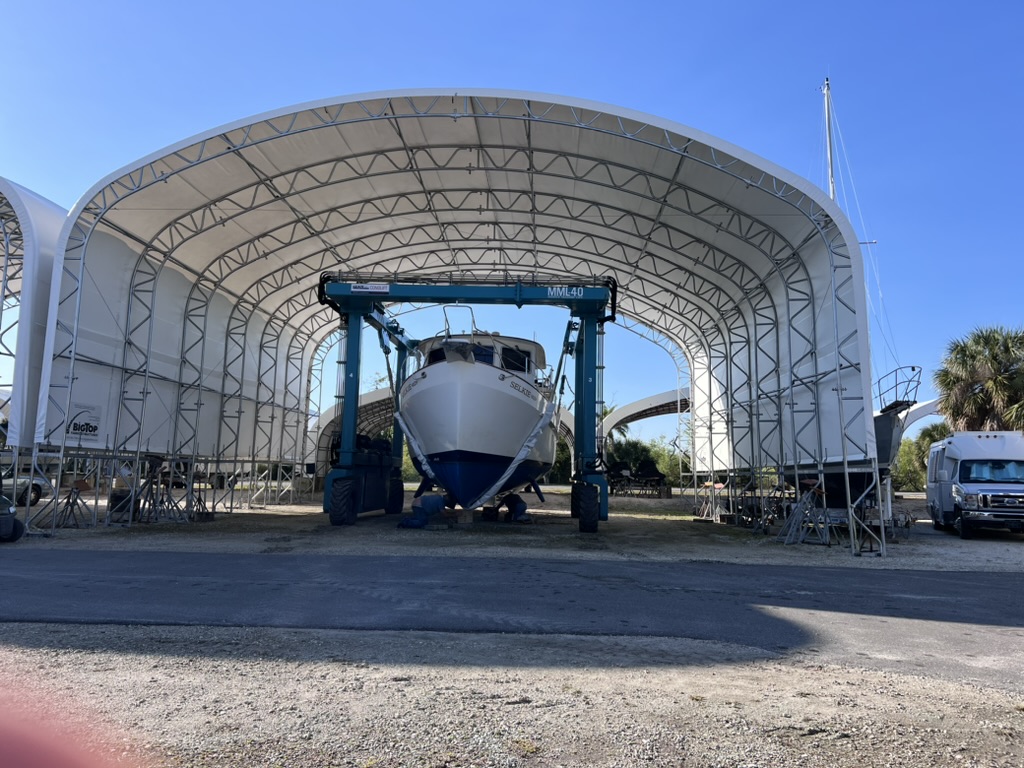
We then put the finishing touches on her, and then went to another friend’s place for dinner, an overnight and a ride to the airport.

Having the temperature and humidity sensor as well as the dehumidifier tied into Safe Cove’s Wifi network helped a lot.
I was able to spend the next few weeks watching the temperatures climb into the high 90’s inside Selkie, but the humidity stayed well in control. I was able to remotely change the dehumidifier to dial things to an optimum level.
And then, we got on with finishing the winter in Tahoe.

We’ve also enjoyed Spring and Summer, in Tahoe and various other places including Mackinaw, with a watchful eye looking back towards the middle Atlantic and Gulf of Mexico for any storm activity.

Many people think that NOAA, the National Weather Service and the National Hurricane Center govern when hurricane season is.
They are not the agencies that really dictate what boat owners should do, though.
It’s the insurance companies.
A typical boat insurance policy will direct the boat owner to store their boat above a certain latitude between May 15 and November 15 every year. That’s when the insurance companies think the biggest risks to their customers are.
Ours was no different, and when we notified them we were storing the boat in Safe Cove below that latitude, they cancelled our insurance.
We did some scrambling and were able to get insurance through another carrier for the season.
The National Hurricane Center had forecasted 2024 to be a major year with many named storms, including several major hurricanes with El Niño coming into play.
However, the La Niña was not going away as quickly as originally forecast, so the period from May through early September was pretty quiet.
But in then the latter part of September, all hell broke loose.
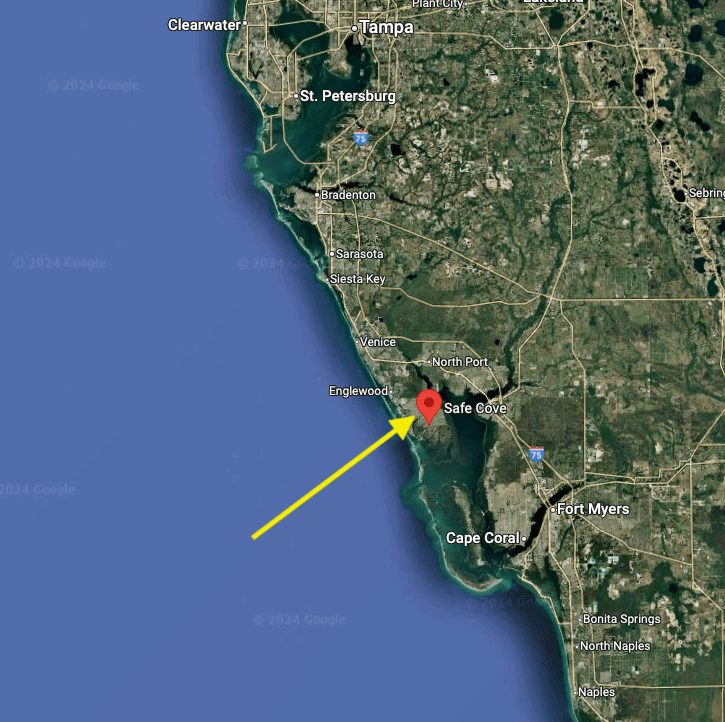
For reference for the rest of this post, here is where Selkie was stored, about two thirds the way from Tampa to Fort Myers:
First, we watched Helen form southeast of Cuba.
The forecasts were not good, with Helene forecast to become a major hurricane before making landfall in the Big Bend area of Florida
For Selkie, she was going to be impacted by Helene somewhat with major rainfall and storm force winds as Helene went by, but the surge was not going to be significant for her. So, we didn’t worry to much about her.
That didn’t meant we didn’t keep an eye on things.
I recorded a webcam at Cedar Key, which was on the south (worst) side of Helene as she came ashore. The webcam went off line as the area lost power, but the video was illuminating.
When I first started watching this, the water was about three times further down the beach before the storm surge started coming in. This was over about a 45 minute period. The sign with the swinging coconut was a tongue-in-cheek weather station with the following: “Coconut Still – Calm, Coconut Wet – Rain, Coconut Moving – Wind, Coconut Gone – Hurricane”. I assum the coconut was gone after Helene passed.
If you followed the news, you know that Helene tore into the Big Bend of Florida as a Category 4 Hurricane. Many of the marinas were severely impacted.
Crystal River, where we had stored Selkie during December 2023 saw a record ten foot storm surge at high tide.
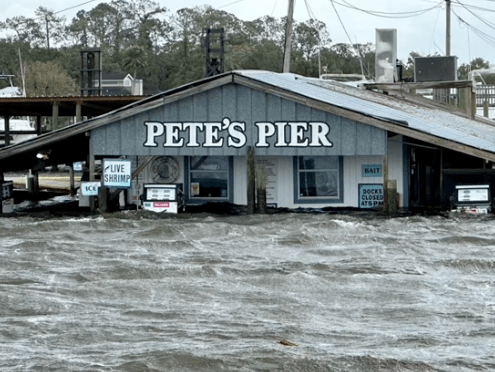
Cedar Key saw similar storm surge, and suffered similar damage.
We breathed a sigh of relief for ourselves and prayed for those we had met in the Big Bend area who were obviously not doing as well as us.
And then, Milton decided to form.
Milton was an unusual storm. Most hurricanes form and head west or north, before curving to the northeast or north.
Milton formed and went east. It was not looking very good according to the predicted storm track by the National Hurricane Center Saturday afternoon, October 5.
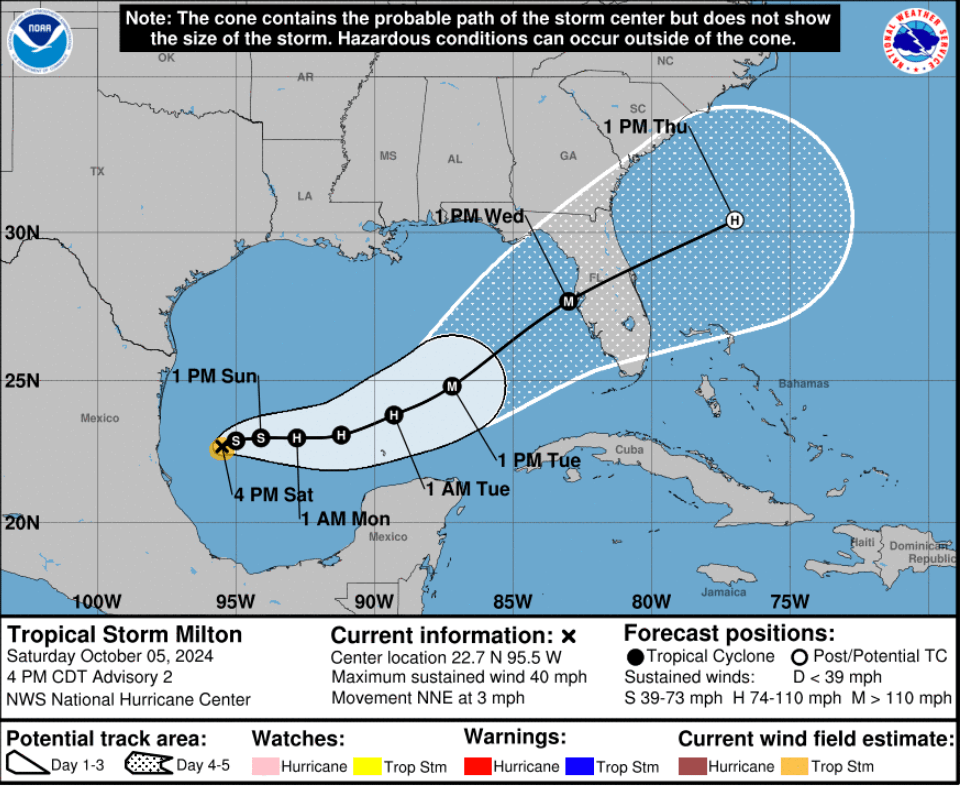
When we first saw this storm track, our hearts sunk.
When you are faced with a hurricane or typhoon, you want to get out of its way as quickly as possible. But if conditions are such that you can’t leave, the absolute worst part of the hurricane to avoid is the side of the hurricane where the winds are stronger.
Let me explain.
Because of a storm’s movement in the northern hemisphere, the right side of the storm, facing the same direction as the storm is moving, is the stronger side of the storm.
So… if a hurricane was experiencing 80 miles an hour in the eyewall of the hurricane, the winds would be the same pretty much around the periphery of the storm if it were stationary. But if the storm is moving 20 miles an hour to the northeast as depicted below, the winds on the right side of the storm could be 100 miles an hour and the winds on the left side could be 60 miles an hour.
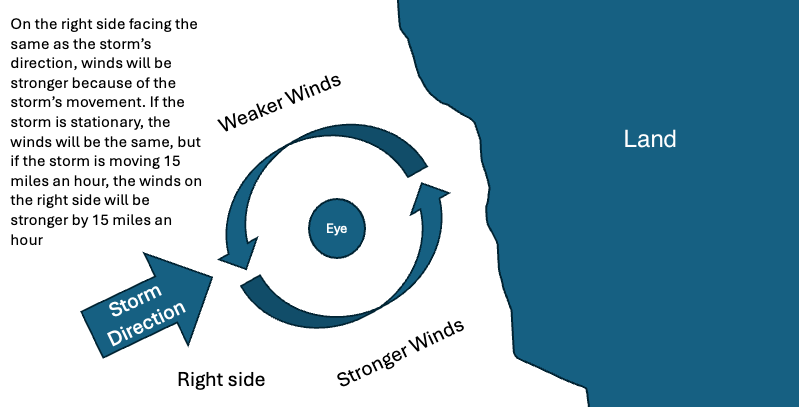
You don’t want to be on the right side of the hurricane.
So, for coastal residents, you want to avoid being on the south side of a hurricane when its moving east, and the north side of a hurricane when its moving west.
But… that’s wasn’t Milton’s plan for Selkie.
According to the National Hurricane Center, Milton was going to be a problem for Safe Cove and the western coast of Florida.
We checked to make sure our insurance was paid up, that Selkie had been strapped down and was ready, and then watched and waited… and prayed.
We ran through scenarios in our heads. What if Selkie is totalled? What if she’s damaged and not totalled?
It was not a very settling feeling watching Milton build to a Cat5 hurricane headed towards her.
As the day of reckoning drew near, we busied ourselves and tried not to think about the impending hurricane. At least we would not be in it ourselves.
We also were exchanging texts with friends who also had their boats at Safe Cove, as well as the friends that had the place with the dock in Punta Gorda where we prepped Selkie for storage.
I got involved in archiving some photo albums and purging the house of things we no longer needed. I guess I was nesting.
Libbie played tennis.
I then sat down and watched the internet, looking at wind speeds and local weather reports. I watched the weather radar.
One thing you immediately notice is that on the southeast side of Milton, while there was indications of strong winds, there was not much rain falling while Tampa and St. Petersburg were getting hammered to the north. That area was recording a half a foot of rain an hour for a few hours.
This was because (luckily for Selkie) a cold front came in from the northwest and collided with Milton, shearing off the top of the storm. This caused Milton to lose a lot of precipitation on the southeast side, right where Selkie was just as the hurricane came ashore as a Cat3 storm
Unfortunately for those on the east side of the Florida peninsula, that caused a bunch of tornadoes to break out. If I had done a larger screen capture, you would see a huge band of precipitation with dozens of tornado warning. Those tornados affected a few friends who live on the east side of Florida.
As Milton made landfall, all the weather sensors in the area went off line. We just had to wait.
Texts started to fly again. “Have you heard anything? No. Let us know if you do.”
Two days later, Safe Cove posted the following:
“Good Morning, we would like to report that it appears we have incurred minimal damage here at the yard. We will be closed temporarily as we assess all damages and insure the yard is safe. Please be patient.”
I wrote to them and was surprised to receive a response on a Saturday.
“Yes, everything is fine. Your boat did great. I will get pictures on Monday.”
I must admit I got a little emotional with this message. We could continue the Loop.
A couple days later, we got photos proving she was in good shape.
Unfortunately, those who were not as lucky as we were in finding safe storage did not fair as well in Punta Gorda.

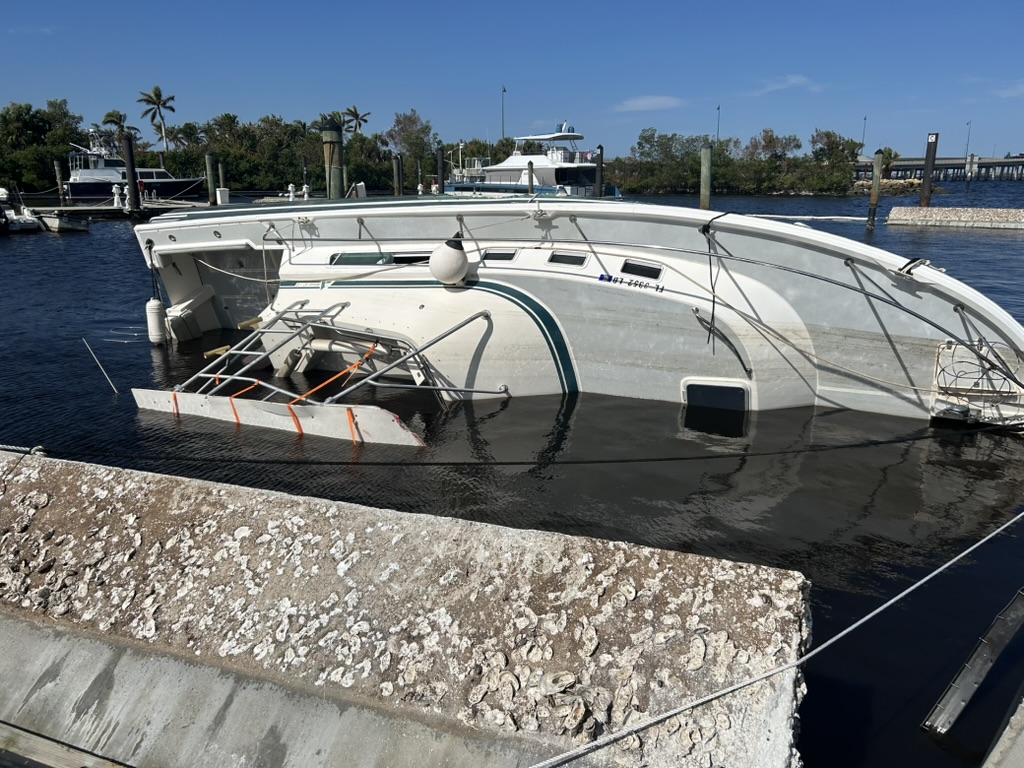
The Loop has been a great adventure for us. Over the 4,700 miles we’ve gone to date, we’ve had wonderful times on Selkie.

We’ve experienced all sorts of things that tried to trip us up and we persevered through all of it.
Hurricane season in Florida is no different. We took precautions where we could, and made sure that things remained ok on Selkie, taking care of her even from a distance.
We think she will return the favor come the end of December 2024 when we clamber back on board her and finish the Loop in 2025.

 Selkie
3 replies on “Whew”
Great post Tad..thanks for the update. So glad she came through well.
LikeLike
Glad to hear Selkie survived the storms. What a double barreled weather punch.
look forward to seeing you as you complete the Loop!!
LikeLike
TAD, Thank you so much for adding me to your blog. Your stories are full of excitement and thrilling to follow. Wishing you and Libbie lots of luck and less excitement on your 3rd part of the Loop. But that would not be as much fun…would it?…Cheers…Maureen
LikeLike