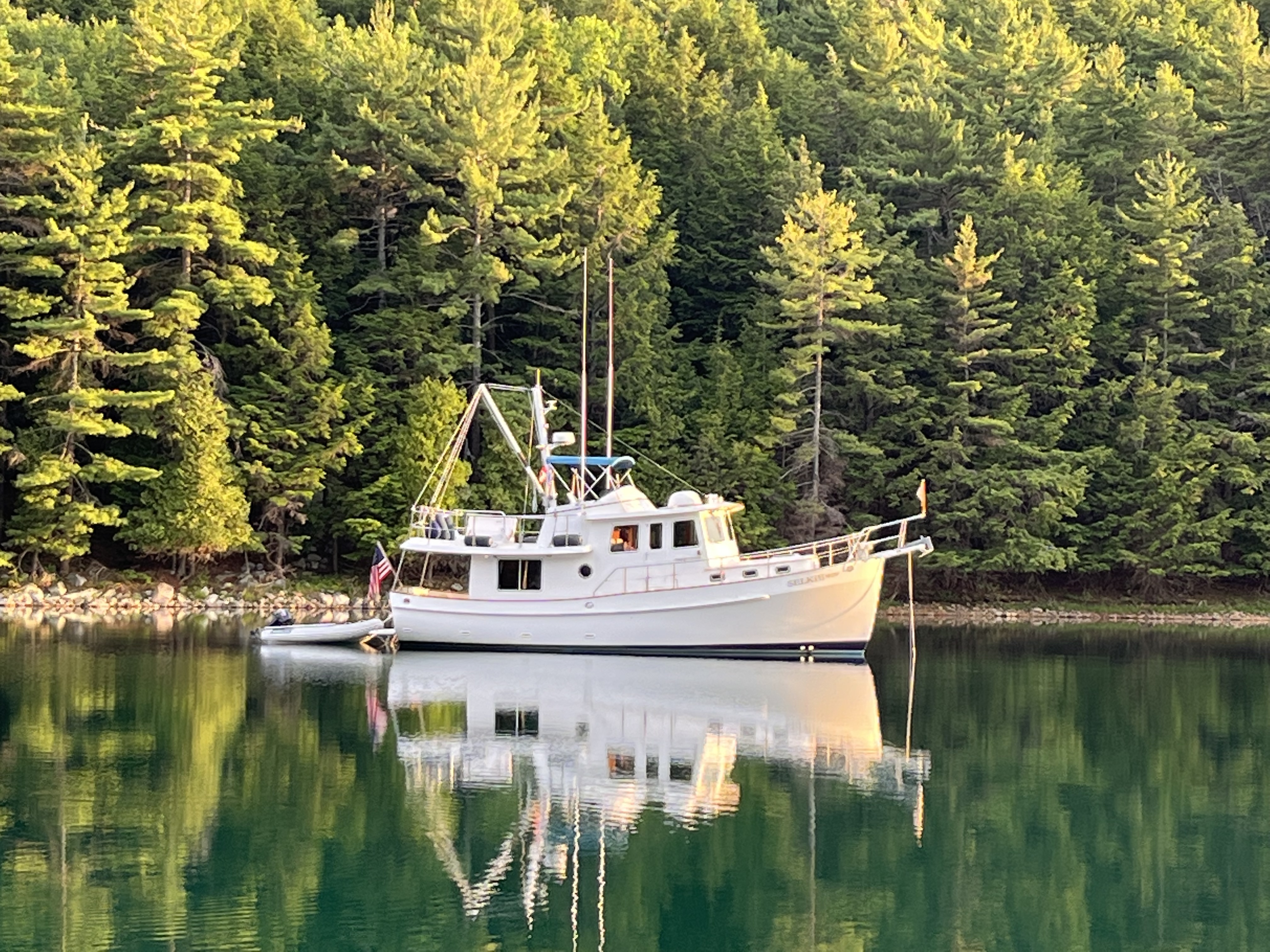
After leaving Beaufort, we headed north up the ICW to Oriental, North Carolina.

We brought my brother-in-law along who used to be a coxswain (pronounced COX-en) in the Coast Guard.
A coxswain is the person who steers a boat and is in charge of its navigation and crew. In smaller boats, especially lifeboats or landing craft, the coxswain has command.
We thought he would be handy to have on board.
He had been number one in his class at the Coast Guard Lifeboat Surf School at the Columbia River in Oregon.
You may have seen YouTube videos of these life boats as they’re practicing handling big waves and breakers. The object is to not roll your boat.
We enjoyed his company on the way to Oriental.
As we crossed the Nuese River the waves got a little choppy on the way to Oriental.
However, the ride wasn’t that bad and we arrived without any issues.
We had a reservation at the Oriental Inn and Marina.
The Oriental Inn and Marina is very much an independent operation with some great owners and hosts. It has a tiki bar with a pool, and is close to some fun shops.
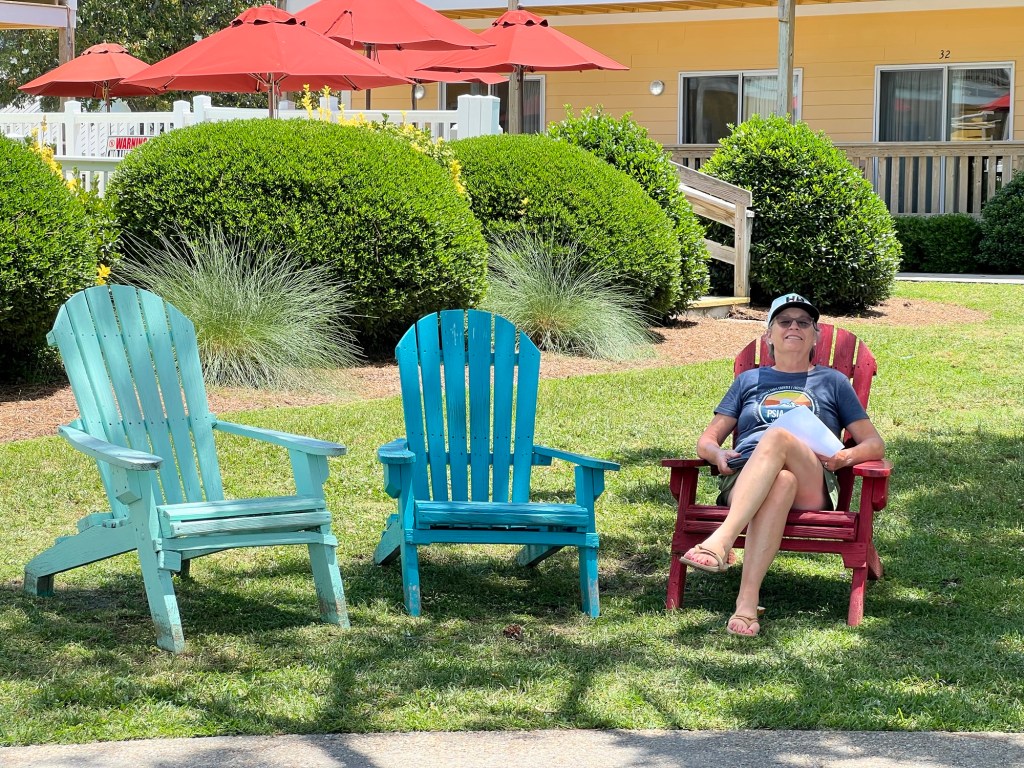
Once we were tied up, we walked around town and did some exploring.
Oriental is a cool little town. I think my favorite store was a marine supply store that had some really great prices. It was too bad that I didn’t need anything for Selkie.
Later that afternoon, my sister came to Oriental with her son and his wife on the ferry from the Beaufort area. We met for dinner at the marina.
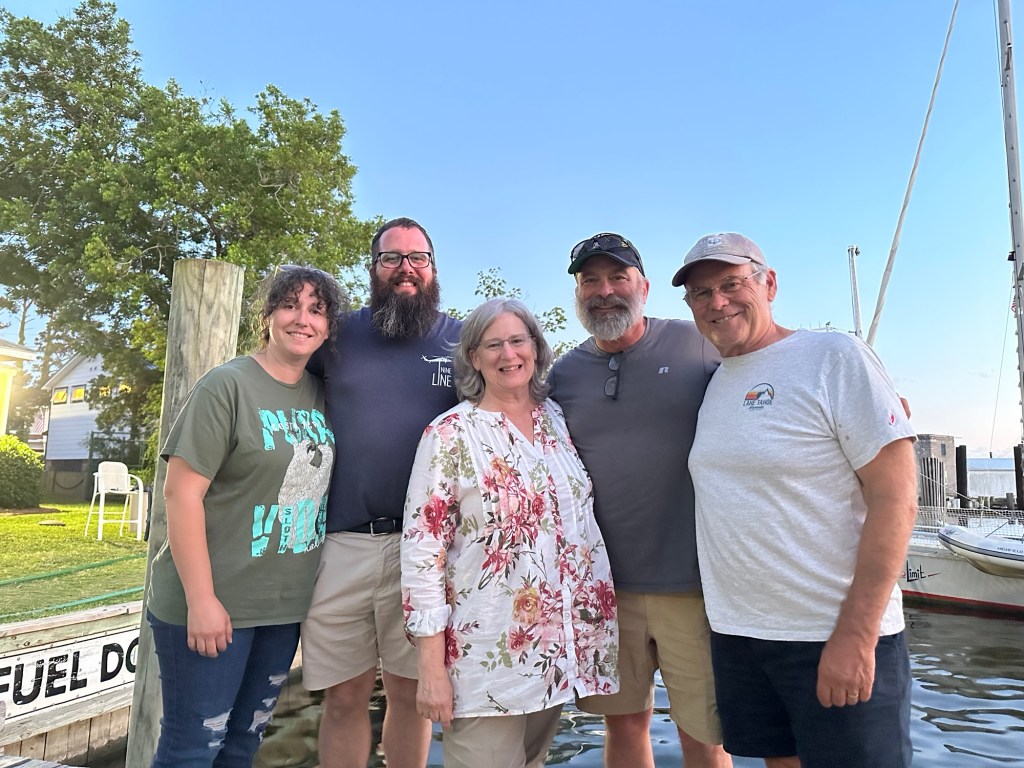
My nephew and wife were fresh back from meeting their new grandchild in Michigan.
Yes, my sister is a great-grandmother, and happy to be one!
We had a great dinner. It was a wonderful way to wrap up our trip to the Beaufort area visiting family.
We said goodbye and went to bed.
The next day we moved up to Bellingham, North Carolina.
We anchored out, dropped the dinghy in the water and went in to Bellingham.

Bellingham is another fun, small town along the coast to North Carolina.
There was a lot of shops and fun places to visit.
We stopped off at a wine store and picked up some wine.
We walked over to where the loopers were docked and enjoyed some of their company, with an impromptu docktales event.
There was a bunch of loopers there waiting out the weather that was coming through the area.
We enjoyed the company of several boats and then went back to Selkie to have dinner. Once again, we settled in for the evening and went to bed.
The next morning we got up, weighed anchor and headed out.
We had a long day ahead of us, including crossing Albemarle Sound. The weather forecast was 10 to 15 kn and one to 2 foot waves.
Those are pretty good conditions to travel and we certainly saw some good calm weather until we got up to Albemarle Sound.
Albemarle Sound is infamous for suddenly kicking up bad weather. For you West Coast sailors, it’s like San Carlos Bay in the Sacramento River Delta with a strong sea breeze and an ebb tide. As we say, it churns and burns.
We stuck our nose out of the ICW channel and started out. Our crossing was expected to be an hour.
The winds were 15 knots… not too bad.
But as we crossed the sound, the winds started building more and more. Unfortunately, we saw winds eventually at 40 knots sustained with higher gusts.
Albemarle Sound is shallow. When it has current and that kind of wind the waves will get pretty vicious.
We saw five footers tightly packed together.
I don’t get seasick, but even I was starting to feel queasy. Libbie laid down in the salon, which is the most stable part of Selkie.
I think even the flies that hitched a ride in Selkie’s pilot house stopped buzzing around because they were getting seasick.
We made the call early on to turn on our stabilizers. It was a good thing we had them because it certainly would’ve been a lot more uncomfortable and probably more dangerous for us.
With stabilizers on, Selkie settled down in terms of her side to side roll, but certainly pitched up and down a lot.
We basically hung on at a slow speed and just worked our way across. By the time we got Elizabeth City, Selkie was covered in saltwater residue.
Our one hour passage across Albemarle Sound had turned into three hours.
We breathed a sigh of relief as we entered the Pasquotank River entrance. We continued another hour up to Elizabeth City.
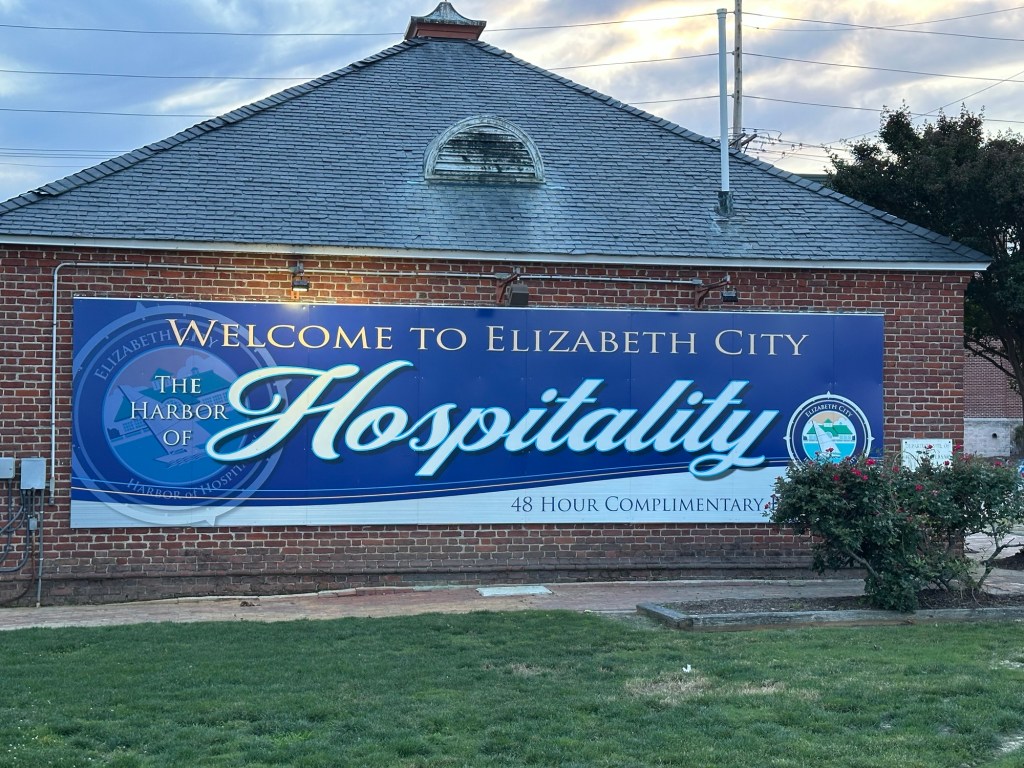
Situated along the Pasquotank River and the Intracoastal Waterway, Elizabeth City has long served as a hub for maritime activity. The city is home to Elizabeth City State University and a major U.S. Coast Guard installation, both of which play key roles in its economy.
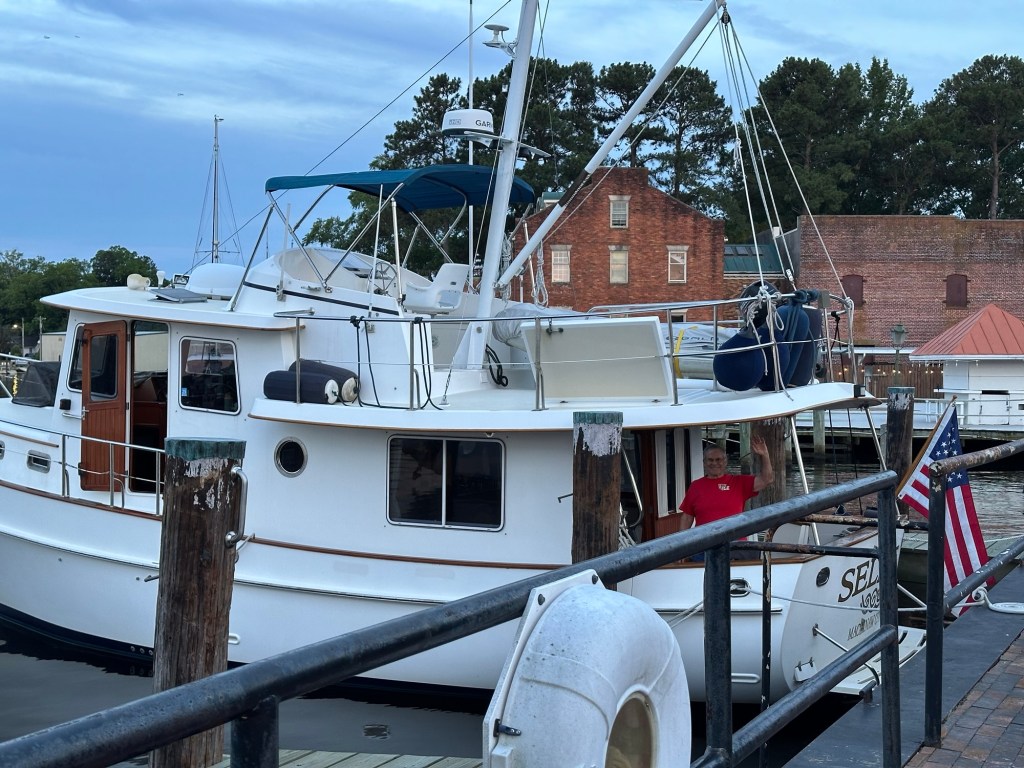
They’ve recently revitalized their old downtown and it makes for a great stop.
We stopped at the visitors center, which doubles as a rest stop for travelers on the highway that parallels the canal for a while.
Elizabeth City has free docks for 48 hour stays for boaters.
We were able to back in our slip without incident.
We had originally planned to spend only one night, but with our rough crossing we were tired and decided to spend two nights there.
We had dinner at a nice restaurant.
The next day, we did some bike riding and provisioning.
We then had some down time, and rested for the next day, when we transited the Dismal Swamp Canal.
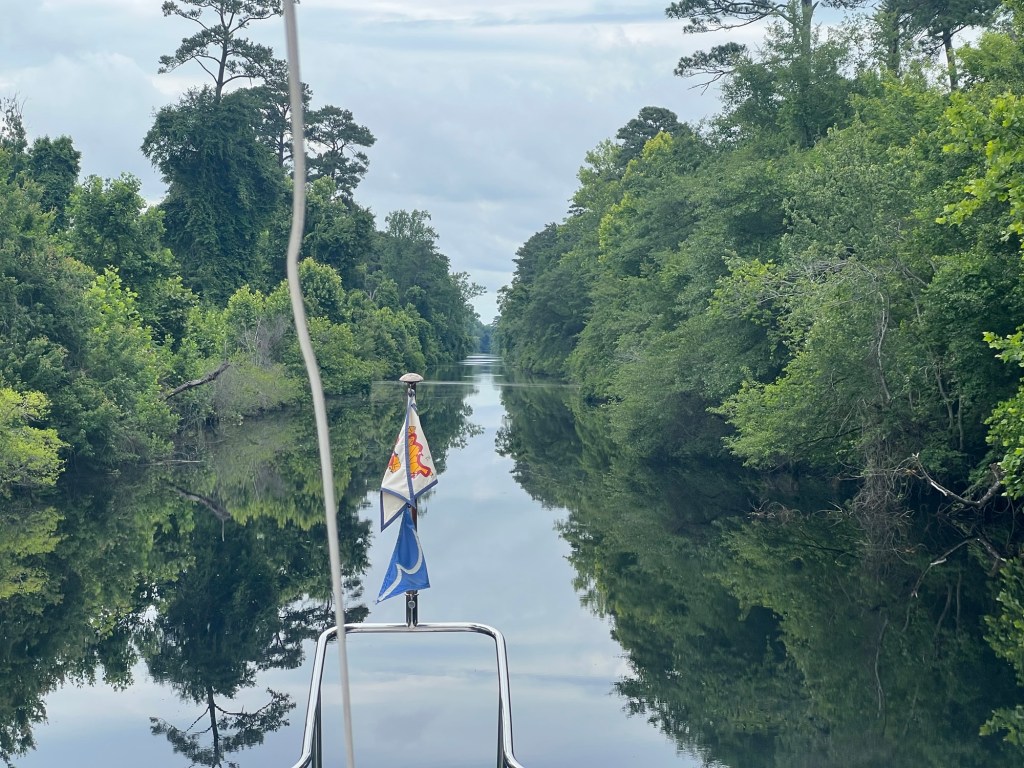
The Dismal Swamp Canal is a fascinating part of US history, occurring after the Revolutionary War.
The canal is one of the oldest continually operated man-made waterways in the United States.
It was conceived by George Washington and his business partners to provide a navigable route between the Chesapeake Bay and Albemarle Sound, driven by a desire to bypass the treacherous open waters of the Atlantic.
Construction began in 1793, Slaves and hired laborers carried out the grueling work of digging the canal by hand through dense wetlands and muck.
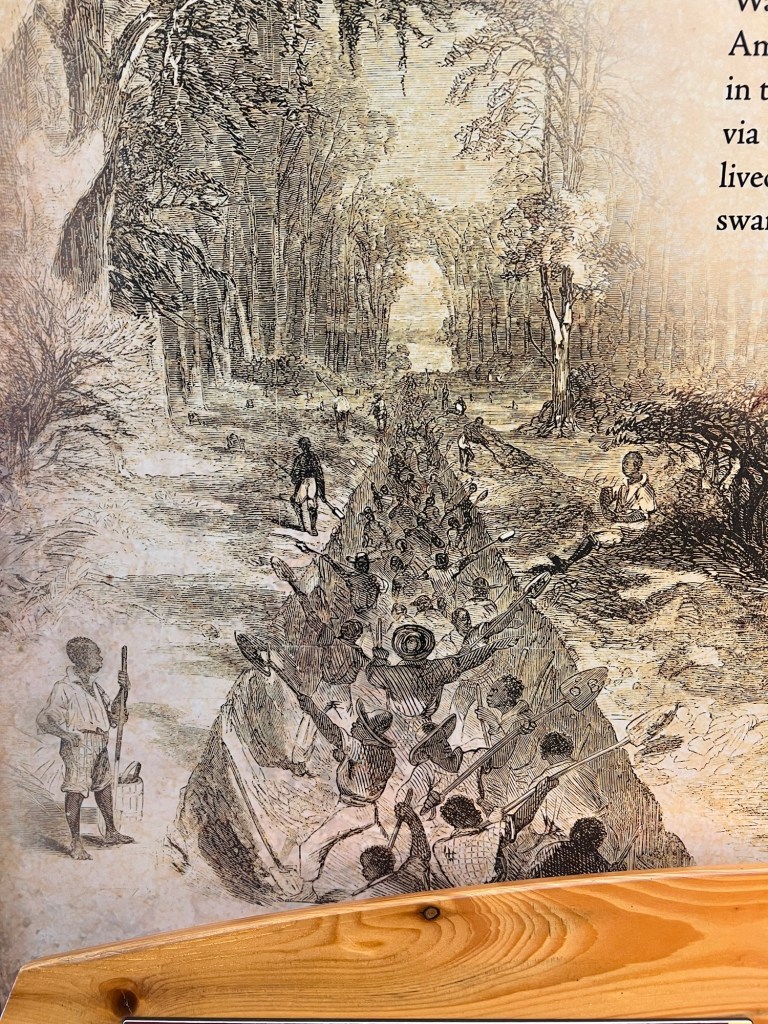
Completed in 1805, the 22-mile-long canal linked Virginia to North Carolina and became a vital route for transporting timber, agricultural products, and goods.
During the 19th century, the canal gained additional importance for its strategic location and commercial use.
It played a role in both the War of 1812 and the Civil War, serving as a route for troop and supply movement.
Despite being slow and narrow compared to later railroads and more modern waterways, the Dismal Swamp Canal remained active, particularly with smaller commercial vessels and later recreational boats.
The canal remains a functional waterway and a heritage site, offering recreational boating, historical interpretation, and access to the Great Dismal Swamp National Wildlife Refuge.
In the 20th century, preservation efforts helped keep the canal operational and historically significant.
Over time, the canal’s traffic declined due to competition from the nearby Albemarle and Chesapeake Canal, which offered a deeper and more direct route.
It was incorporated into the Intracoastal Waterway system and managed in part by the U.S. Army Corps of Engineers.
The swamp is a beautiful place.
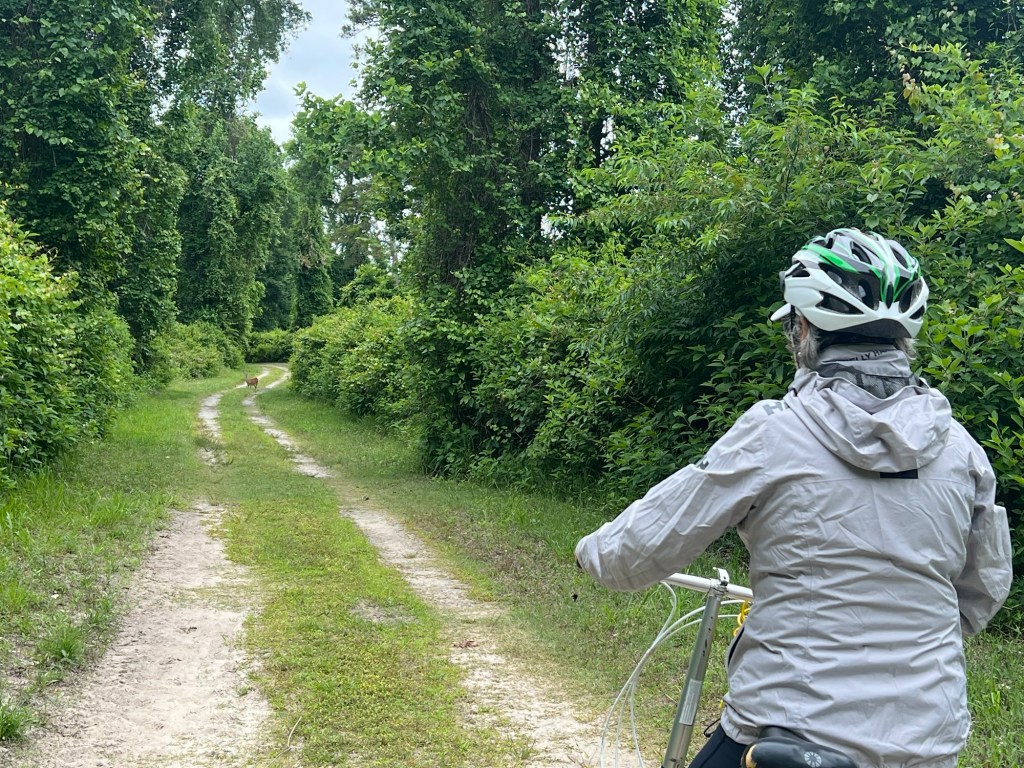
The lush undergrowth combined with the tall trees along the canal is full of birds and deer.
We had to watch our path and speed coming through the canal because it was shallow, and there are submerged logs and stumps.
We bumped something on the bottom about four times transiting the canal.
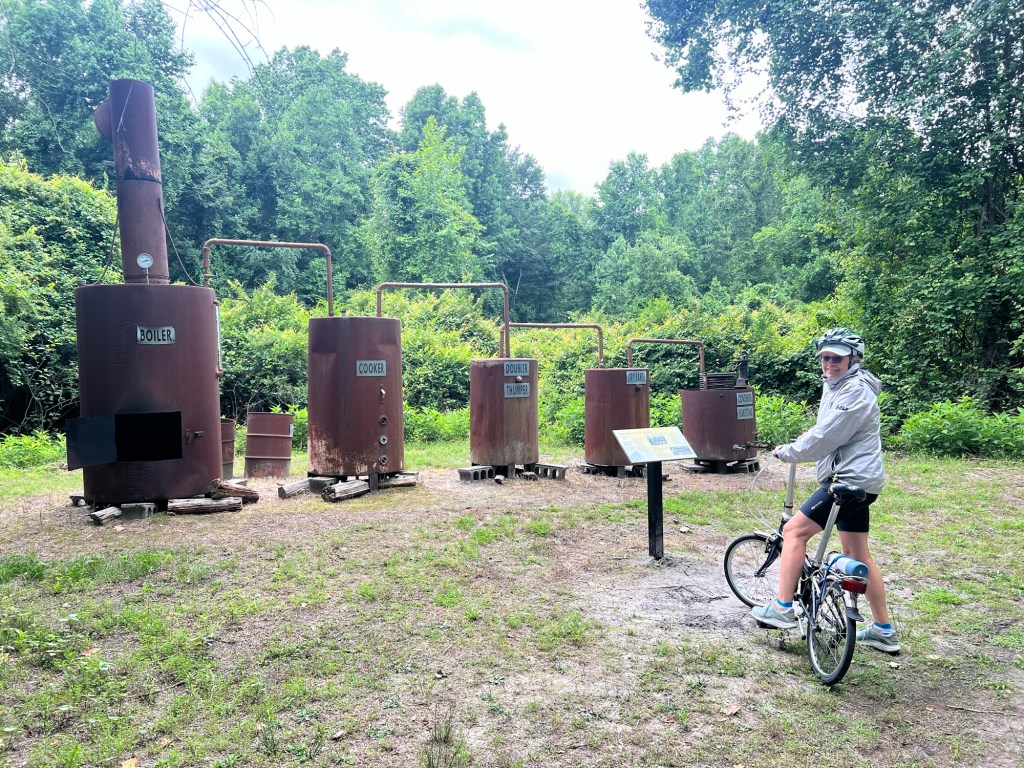
We got our bikes out and followed the bike paths along the canal. We ran across an old moonshine still, and saw some deer. We had a good time exploring.
We continued on to our next stop, crossing from North Carolina into Virginia, our last state to visit on the Great American Loop. There was even a sign on the Canal saying, “Welcome to Virginia.”
Thinking back on it, that was actually a momentous occasion for our adventure, although it didn’t seem like it at the time. We’ve now visited 17 states and one Canadien province on the Loop.
Our overnight stop was a sea wall by a lift bridge at the north end of the canal. We tied up at the wall by the bridge for the evening.
The next morning, we took off for Norfolk, Virginia.
Norfolk is a trip back in to Memory Lane for me.
I visited the area several times when I was working for my first company after college. My work supported the US Navy with marine propulsion machinery.
I enjoyed seeing many of the classes of ships that I had either been on or had worked with (including a few I actually visited) more than three decades ago.
My highlight was seeing the George H. W. Bush. I’ve been on three aircraft carriers. When the Bush was under construction, I remember looking at the reactor spaces below from the unfinished flight deck.

It was an experience I’ll always remember.
Our plan was to go through Norfolk and out into the south end of the Chesapeake Bay to Little Creek Marina.
We had some very good friends of ours that we were going to pick up at a marina along the way. We were able to successfully do a touch and go at the marina dock and get them aboard safely.

As we headed out to Little Creek Marina, we continued along all of the navy ships in some commercial vessels docked in port.
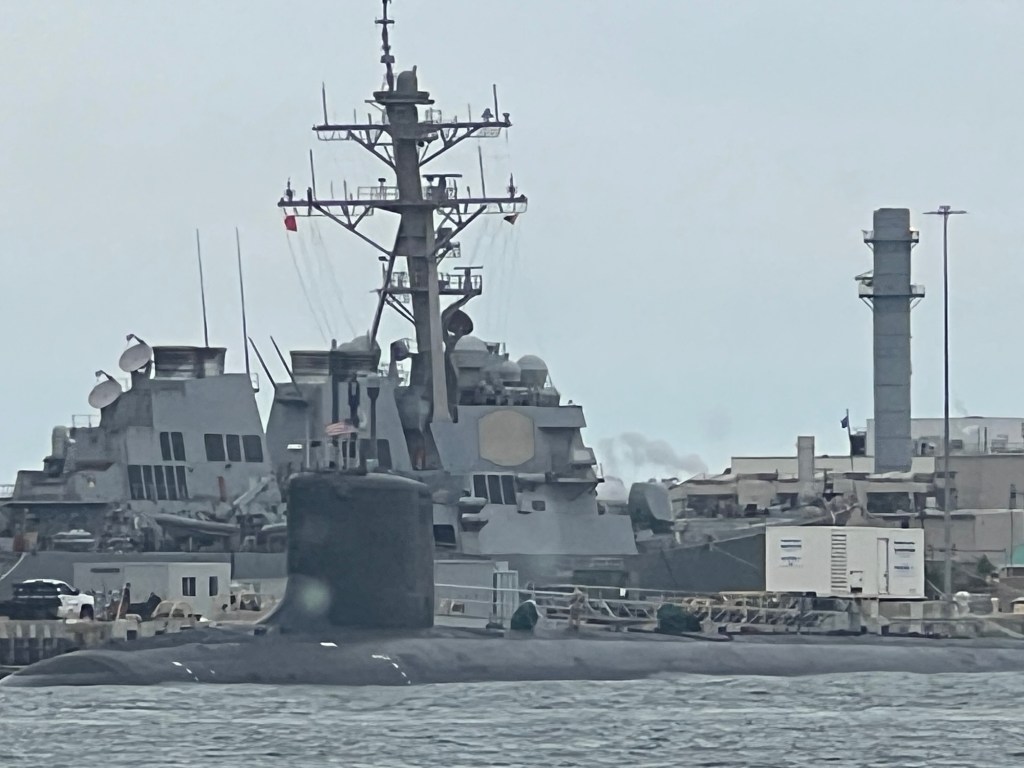
Three aircraft carriers, including the Bush were being worked on.
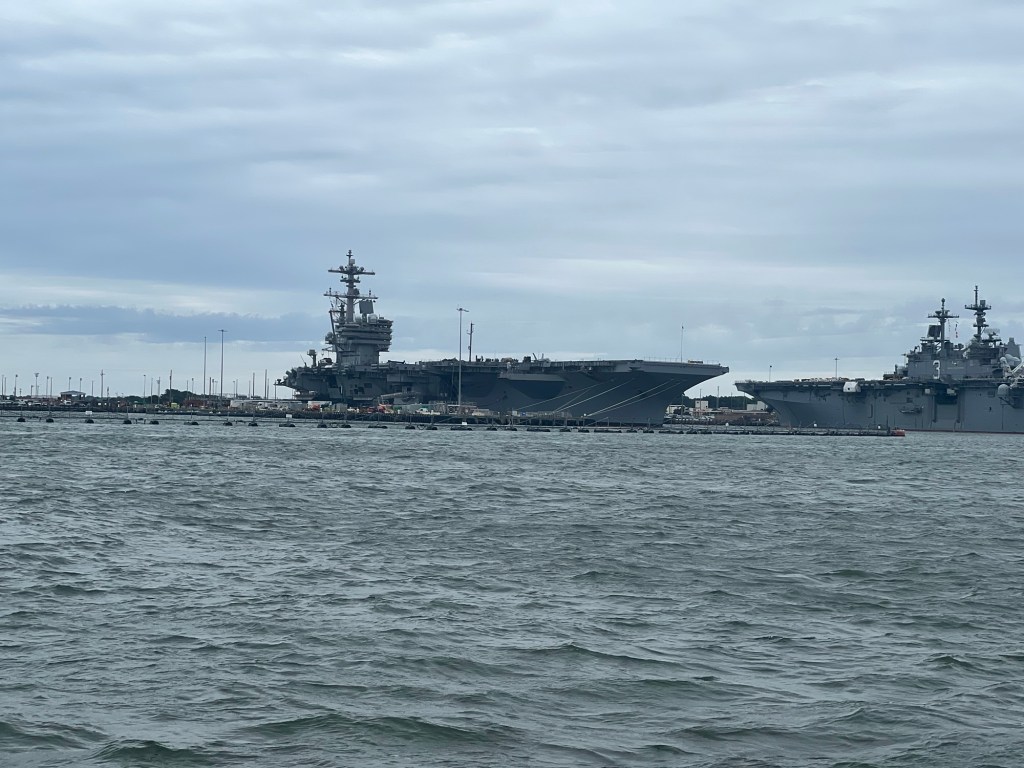
We rounded the point and started heading into the Chesapeake Bay.
The wind and the waves were picking up and it looked like it was getting a little rough. I grabbed the binoculars to take a look ahead and realized that we were going to be in for a rough crossing, so we made the call to turn around and go back to the marina where we originally picked up our guests.
We docked, breathe a sigh of relief and then went out for a great dinner.
The next morning we met up with our friends again and went to visit the Battleship Wisconsin.
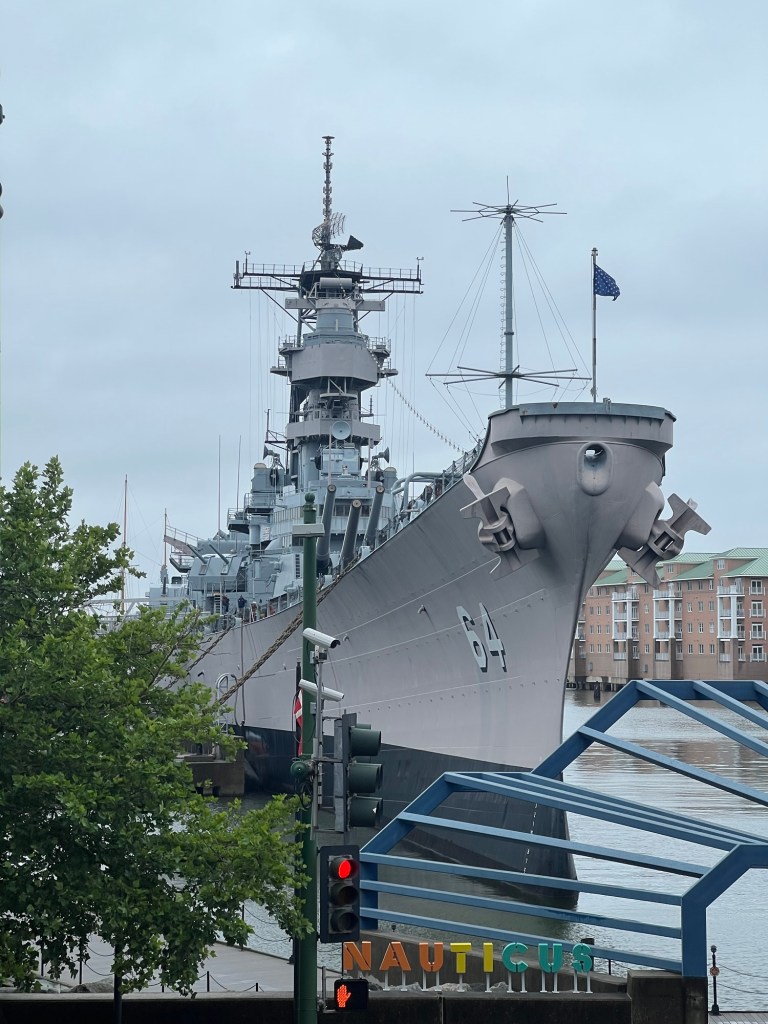
It’s an impressive ship from a distance and even more impressive when you stand on her decks looking at the big guns.
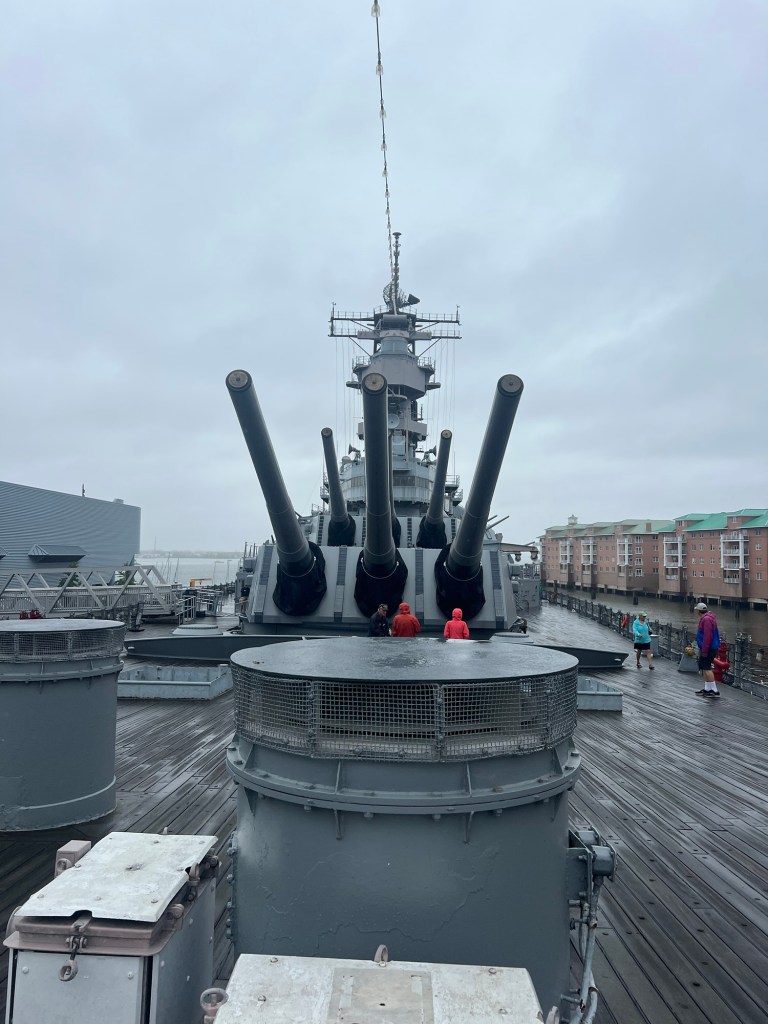
I had worked on the Wisconsin back in the mid 1980s. It was fun to walk around her deck spaces where the public could go and take a look.
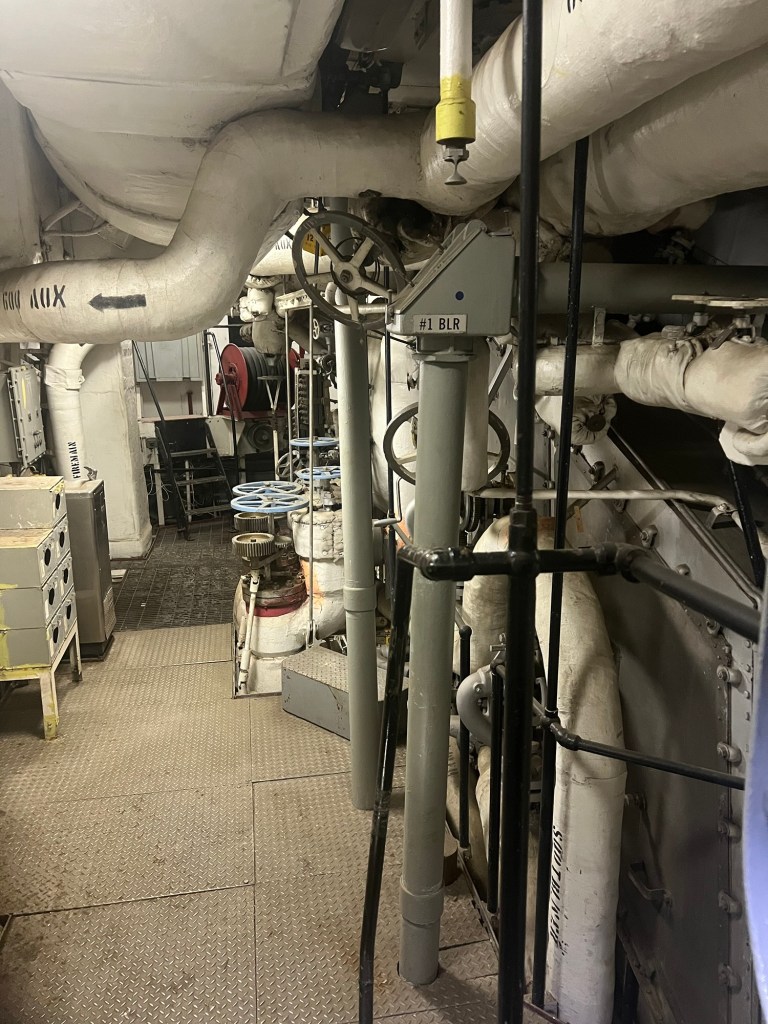
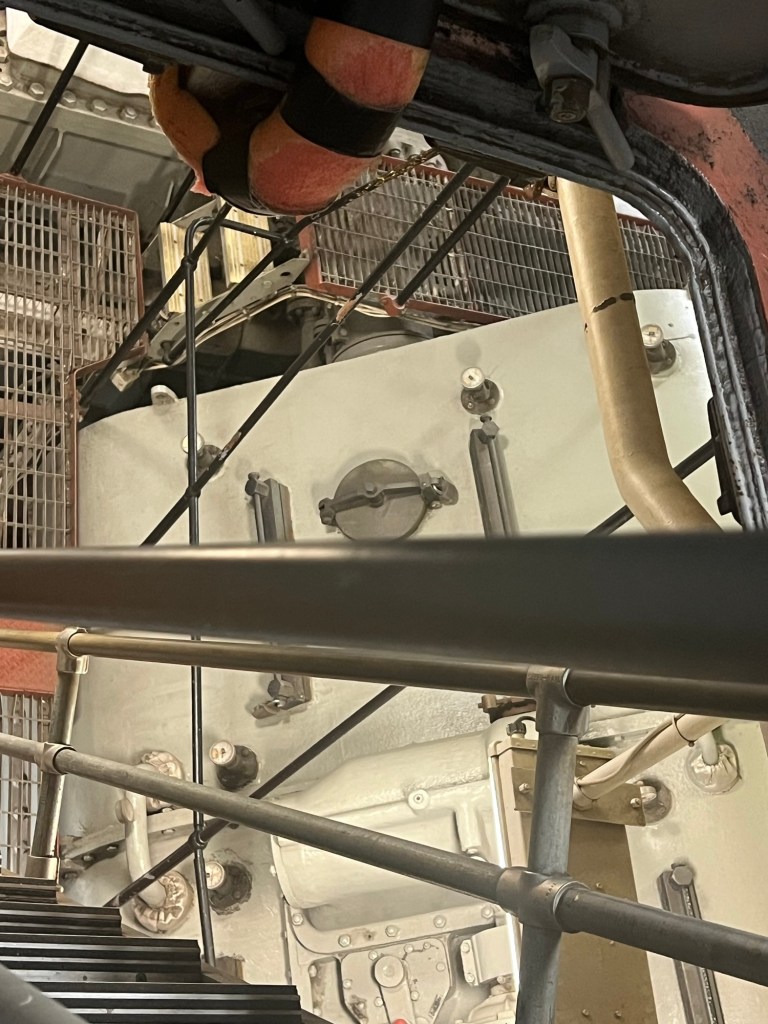
I was able to peek into the engine room in a couple of spots.
We said goodbye to our friends and then went back to the boat.
The next day the winds were calm and Selkie enjoyed her trip to Little Creek Marina.
Unfortunately, we had some personal business to take care of back home in Lake Tahoe that prevented us from continuing on a little bit.
Our plan was to leave Selkie at Little Creek Marina for the summer.
If I thought about it, it was frustrating was that we only had 90 miles to go to finish our loop in Solomons Island, Maryland.
But our business was more important and so we chose to leave her at Little Creek.
We packed up, did all the prep work that Selkie needed for a long stay at the dock, called an Uber and departed.
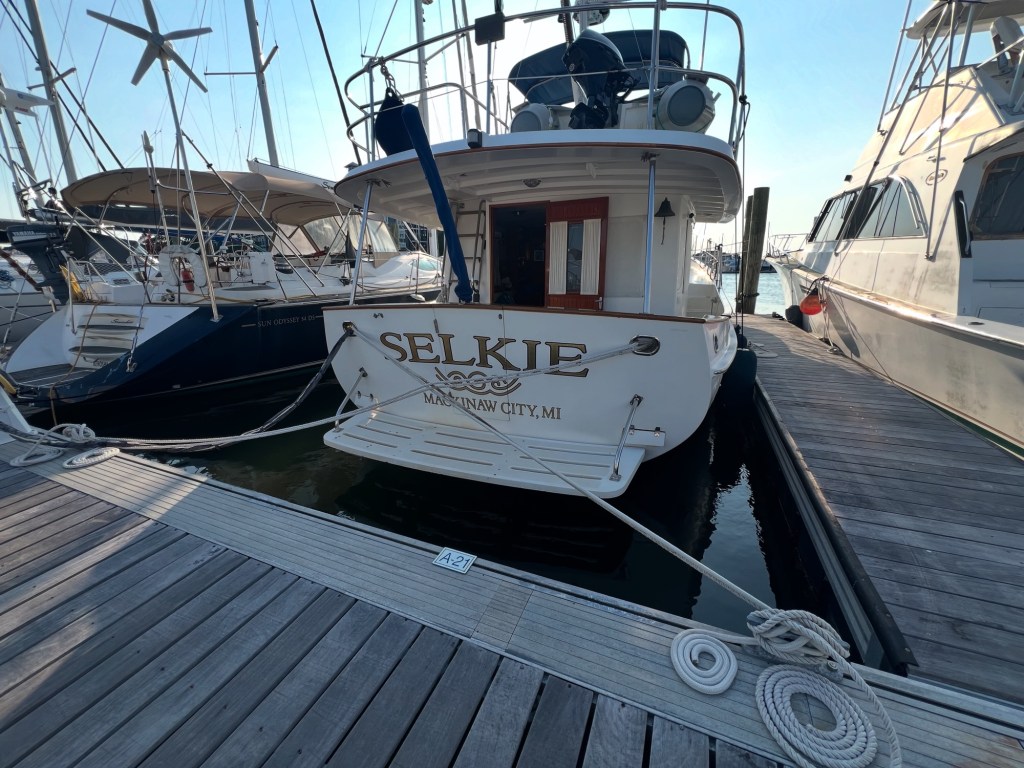
The Loop has been months of traversing the waterways of the Eastern United States and Canada, followed by a need to be home for months in Lake Tahoe. Whereas it has sometimes been frustrating to interrupt our Loop, it’s really been a blessing to be able to do both.
After starting our Loop in May 2022, with some good luck we will be able to cross our wake in September 2025 and conclude this wonderful adventure called the Great American Loop.

 Selkie
One reply on “Rough Water and Memories”
Wonderful trip log.
LikeLike