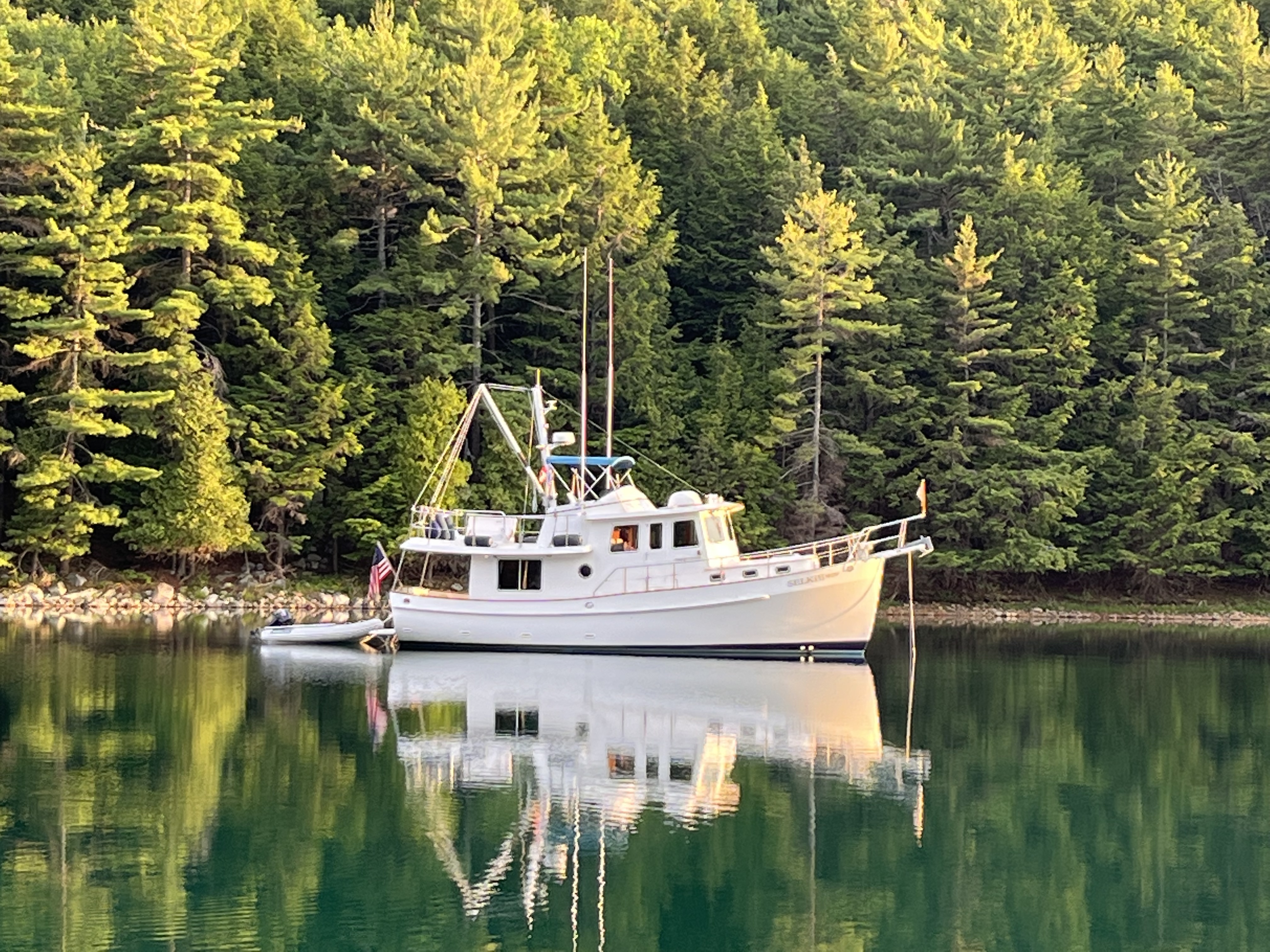
We headed up to Myrtle Beach, where we docked at the Myrtle Beach Yacht Club for the evening.
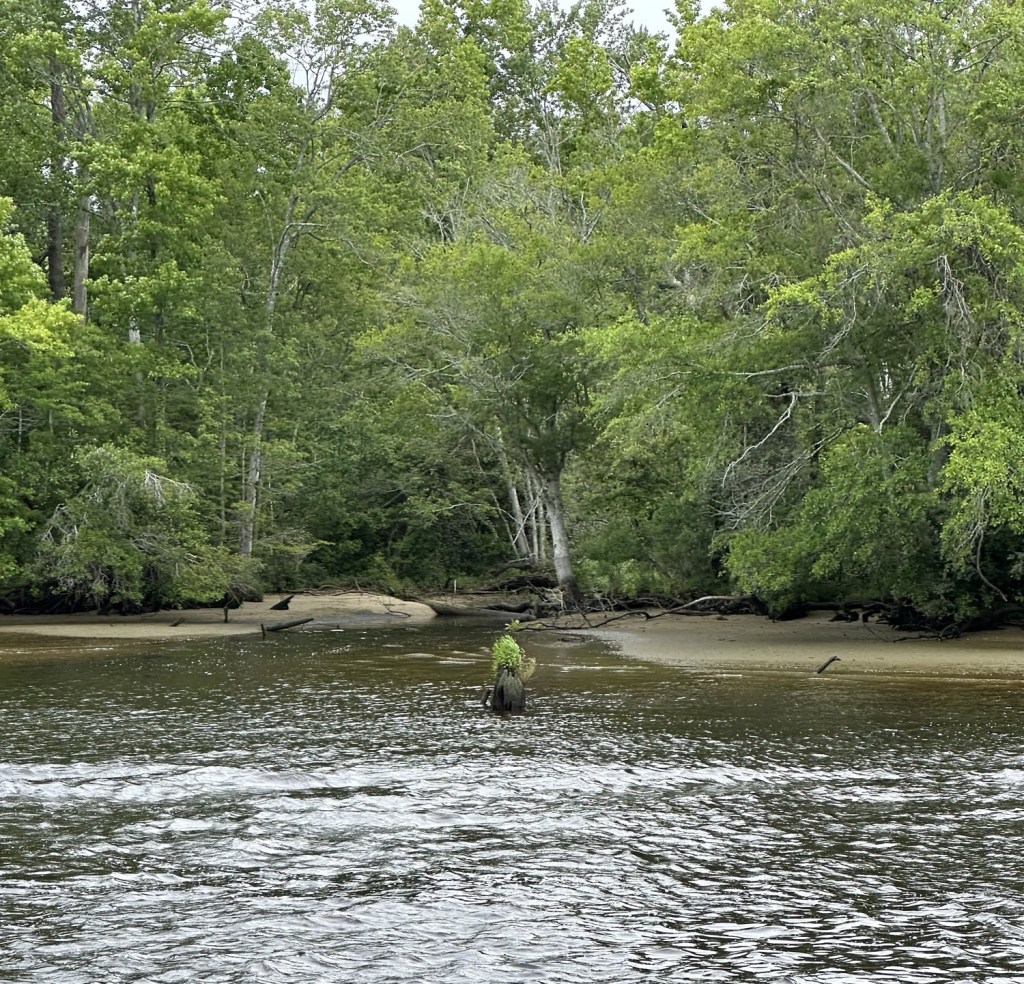
I did some maintenance on Selkie so I didn’t have much time to see the Myrtle Beach area.
It would have been nice to explore a bit, but we were back on a scheduled deadline to get to Beaufort, NC to spend time with my sisters and some of their families.
The next day we went up to Wacca Wacha Marina at Murrels Inlet.
Wacca Wacha is a nice Marina with a good restaurant. It’s not far from the town center of Murrells Inlet.
We settled in for the night and had a nice meal at the restaurant.
It really is amazing how we run into people on the loop.
My brother-in-law called me and asked when we would wind up in Beaufort. I told him it was going be two or three more days before we could get up there depending upon the weather. He then asked where we were.
I said we were at the Wacca Wacha Marina in Murrells Inlet, North Carolina.
He said, “My mom lives in Murrells Inlet!”
We have not seen his mom for a long time. She is a very generous and loving person.
I called her that evening. She was thrilled to hear from us and we agreed to meet for breakfast the next morning
Talk about a small world.
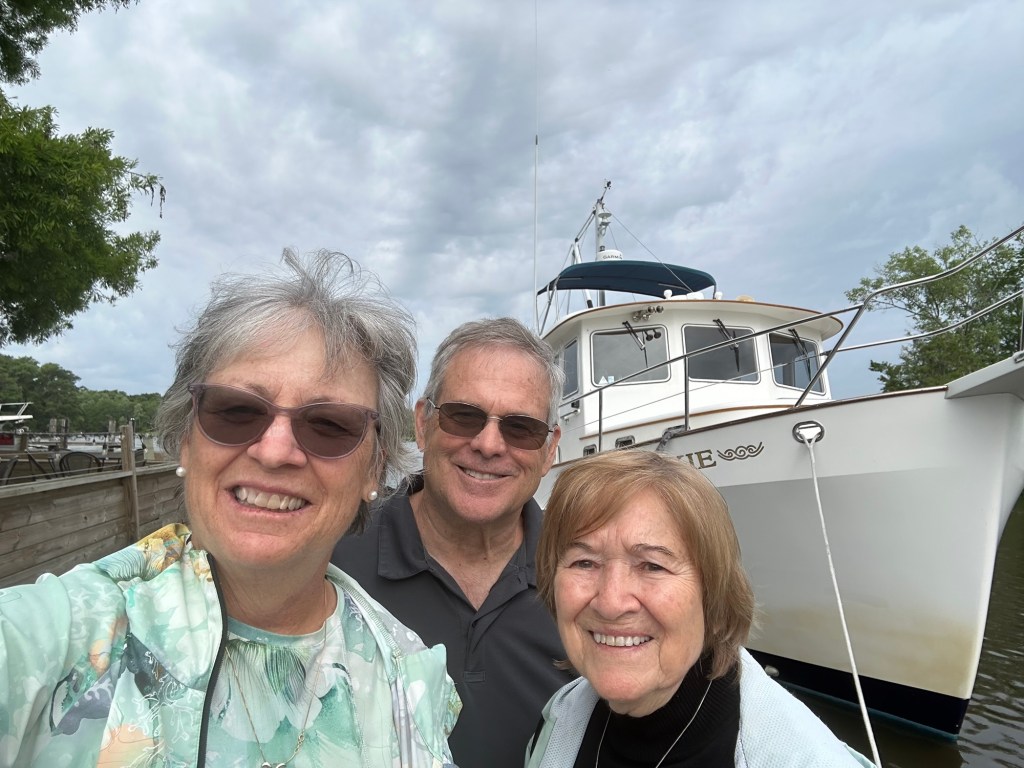
She came over to the marina and we showed her the boat.
We then went out to breakfast and got caught up. It was a great morning and we enjoyed her company.
Soon it was time for us to depart so we said goodbye and headed on up the ICW.
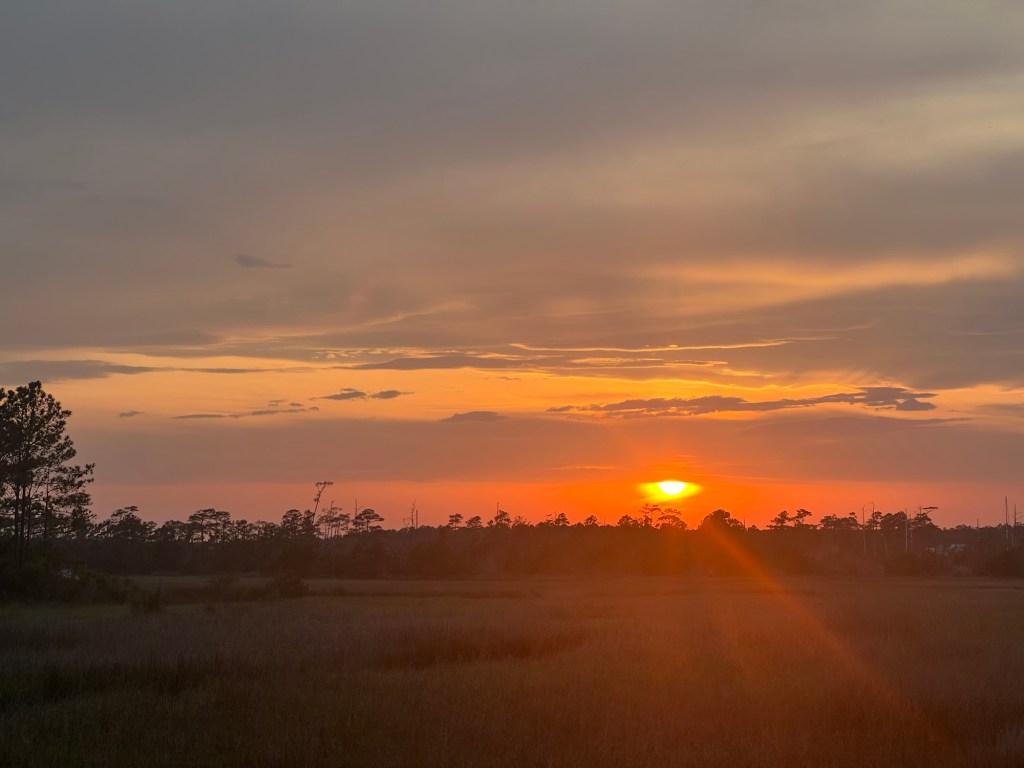
The area around Murrells Inlet, NC is a scenic area on the ICW.
We started to see the scenery change as we left Low Country.
The salt marshes transitioned to stands of Cypress and Pine on higher ground. The river curved back-and-forth. The scenery and wildlife were beautiful.
There was a popular anchorage called Mile Hammock Bay by the US Marines Camp Lejeune Base. We were the first in the anchorage, but soon we had company.
A couple of thunderstorms blew through before dusk.
A total of a dozen boats anchored overnight in the bay during that time..

We went to bed.
When we anchor, I sleep well, but I’m up two or three times a night to check on things. I was up at 1:00 am and looked around, but didn’t see anything amiss.
Libbie woke up at 3:00 am to see bright light shining through Selkie‘s window.
That was very strange.
She got up and looked out a porthole, and yelled, “We’re about to get hit!”
There are several things that can give a person cardiac failure.
One of those is when you are asleep on a boat at anchor at 3:00 in the morning and someone wakes you up by yelling “We’re about to get hit!”
I scrambled out of bed and was in Selkie’s pilot house in a flash to assess the situation.
That’s when I learned that there is another source of cardiac failure: seeing a 55 foot boat that outweighs you and dragged their anchor to the point they are about to run your own boat over.
The lights Libbie had seen came from underwater lights off the stern of this 55 foot boat.
Their boat was closed up with shades drawn and their generator running to give them air conditioning,
They were swinging about fifteen feet off our bow in a very wide arc.
They had originally anchored about 100 yards from us, but because their boat was swinging so much in the strong breeze, and because they had not let enough anchor rode out to help the anchor stay set, they had dragged.
They were very close to hitting us.
To avoid a collision we needed to let our anchor chain out to drift back and give us some space while we woke the other boat.
Unfortunately the anchor chain was held in place by an anchor hook attached to a nylon line bridle,
I had to release the anchor bridle from the chain, and to do that, I had to pull the anchor chain in, which brought us closer to the other boat, jeopardizing us even more.
I timed the swing of their boat, brought the chain in, released the chain hook, tossed it over the side in a matter about 15 seconds.
I then let the anchor chain out so Selkie could start drifting back, but unfortunately it wasn’t fast enough.
I saw them swinging into us.
I jumped into the bow pulpit and braced myself to fend off the other boat with my legs, and that was partially successful. They banged into our secondary anchor.
I then started Selkie’s engine and genset to give us maneuverability if we needed it.
We proceeded to yell and blow Selkie’s horn. Libbie showed our spotlight in every porthole she could.
With their generator running, it took a while for them to wake up, but thankfully they did, and relocated their boat to its original location.
I assume they set a longer anchor line as they stayed put the rest of the night.
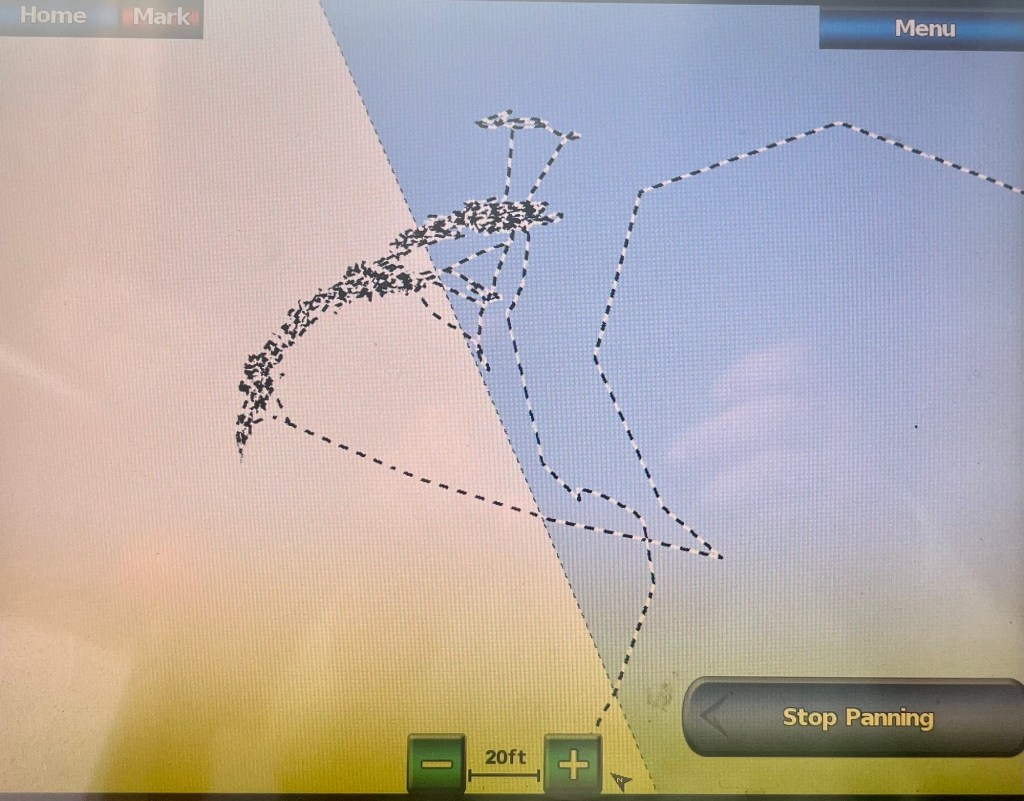
In hindsight, there’s always lessons learned, and as a result there are a few things I could have done differently.
I could have just tossed the bridle overboard with the anchor chain attached.
That would have allowed Selkie to drift back out of danger more quickly, and we likely would not have made impact.
But we risked losing the bridle if the hook became detached from the chain.
I should have not jumped into the bow pulpit to fend off Selkie from the other boat.
My legs might be strong, but they can’t fend off a sixteen ton boat very well.
However, I did help cushion the blow, and as a result Selkie escaped with just the impact on the anchor on the bow pulpit, and not on Selkie herself.
More importantly, I didn’t break a leg doing it.
I could have spent the night in the pilot house sleeping on the settee with the winds.
There were a lot of boats in the anchor with a lot of wind. We would have had an earlier warning as I would have been awake more often.
As it was, that’s where I spent the rest of the night.
Ultimately it was Libbie who saved the day for us by waking up and realizing the danger we were in.
The next morning, we left Mile Hammock Bay and continued up the ICW. We were ok, except for our 3:09 AM wake up and the close call we had.
Experiences like that make the Loop an interesting adventure.
I’m just glad we came out of it without a scratch.

 Selkie
5 replies on ““We’re About To Get Hit!””
Yikes, that was too close. So glad legs, heart and spirits are intack.
LikeLike
Wow! What a story! Happy to hear all is well including your legs! Lessons learned but mishaps happen. Stay safe and have fun enjoying your time on the loop. Allison T
LikeLike
I am glad that you are ok and intact.
Forgive me if this is a stupid question because I don’t know anything about handling a boat like Selkie.
My first instinct would have been to get the engine running to gain some mobility even if the boat was still at anchor. Wrong move?
LikeLike
Good thing Libbie Libbie is a light sleeper
LikeLike
Close call. Stay Safe!!
LikeLike